What Is Moisture Wicking Fabric? How It Works, Best Materials & Complete Care Guide
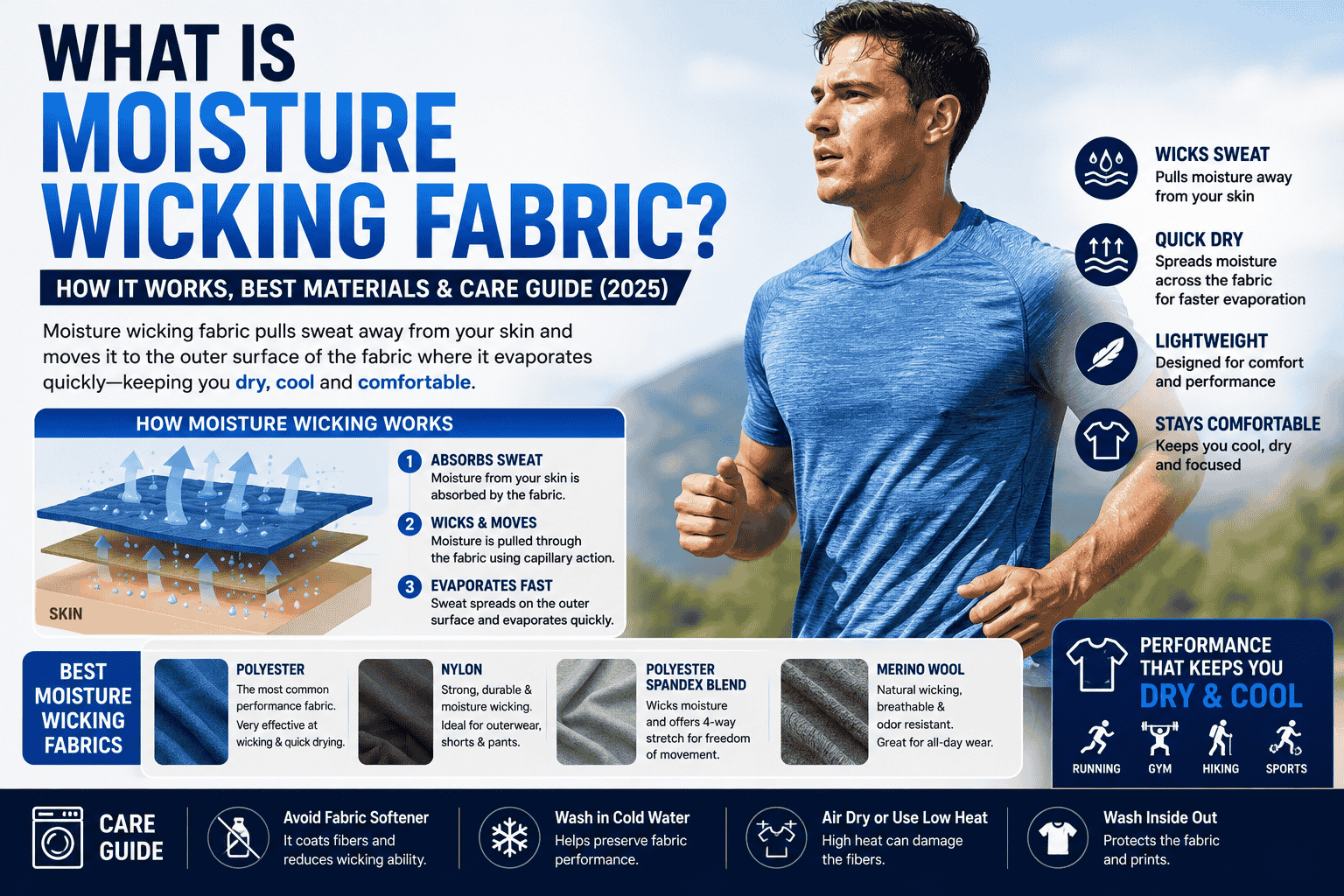
Quick answer: Moisture wicking fabric is any textile engineered to pull sweat away from the skin surface and move it to the outer surface of the fabric where it evaporates quickly. 'Wicking' refers to the capillary action that moves moisture through the fabric fibers — the same physics that draws liquid up a candle wick. Polyester is the most common moisture wicking fabric. Cotton is NOT moisture wicking — it absorbs sweat and holds it against the skin.
If you've ever finished a workout in a cotton t-shirt that felt like it weighed three pounds and was plastered to your skin — and then tried a performance shirt that stayed light and relatively dry through the same workout — you've felt the difference moisture wicking fabric makes. The difference isn't comfort alone: a shirt that manages sweat effectively regulates your body temperature, reduces chafing, and prevents the prolonged skin contact with wet fabric that leads to rashes and irritation.
This guide explains what moisture wicking fabric is and how it works at a fiber level, which fabrics are moisture wicking and which are not, the best moisture wicking shirts and clothing for every program type, and how to care for moisture wicking garments to maintain their performance over time.
What Is Moisture Wicking? — The Definition and Meaning
'Wicking' is a physics term describing capillary action — the movement of liquid through a porous material against gravity, driven by surface tension and adhesion forces between the liquid and the material's surface. The term comes from the candle wick: the solid wax melts at the flame, but liquid wax is drawn up the wick by capillary action to feed the flame continuously.
In fabric science, moisture wicking describes the same process applied to sweat management in textiles. A moisture wicking fabric is designed to:
-
Pull sweat from the skin surface: the inner surface of the fabric draws sweat away from direct skin contact through capillary channels between tightly woven or knit fiber surfaces
-
Transport moisture through the fabric: the capillary channels carry the sweat from the inner surface, through the fabric layers, to the outer surface
-
Spread moisture across the outer surface: the sweat is dispersed across a larger area on the outer surface — increasing the surface area available for evaporation
-
Evaporate quickly: moisture spread across a large surface area at the outer fabric surface evaporates far faster than moisture held against the skin inside a saturated cotton fiber
Moisture wicking meaning in simple terms: the fabric actively moves sweat away from your skin to the outer surface where it dries fast. You stay drier, cooler, and more comfortable during physical activity than you would in a non-wicking fabric.
How Does Moisture Wicking Work? — The Science Explained
The mechanics of moisture wicking in performance fabrics operate through two combined physical phenomena: hydrophobicity of the fiber material and capillary action in the spaces between fibers.
Step 1: Hydrophobic Fiber Surface
The key property of polyester — the most common moisture wicking fiber — is that it is hydrophobic: it repels water at the fiber level. A cotton fiber absorbs water molecules into the fiber itself (cotton is hydrophilic — it loves water). A polyester fiber does not absorb water into the fiber; instead, water sits on the fiber surface.
This sounds like it would make polyester bad at moisture management — but the opposite is true. When water cannot enter the fiber, it is free to move along the fiber surface and between fibers through surface tension. The fiber does not hold onto the moisture; it releases it.
Step 2: Engineered Fiber Cross-Sections Create Capillary Channels
Performance moisture wicking polyester uses fibers engineered with non-round cross-sections — channeled, star-shaped, or multi-lobal fiber geometries that create microscopic channels along the fiber length and between adjacent fibers in the yarn. These channels act as the 'wick' — drawing moisture through capillary action from the inner surface toward the outer surface.
Standard round-cross-section polyester has some wicking ability due to the hydrophobic fiber surface. Engineered-channel polyester wicks significantly more effectively because the channel geometry dramatically increases the surface area and the directionality of moisture movement.
Step 3: The Knit Structure Directs Moisture Movement
The knit or weave structure of the fabric also affects wicking performance. Most performance wicking shirts use a jersey knit or mesh knit construction with a specific inside-to-outside moisture gradient — the inner surface fiber density is higher (more fiber-to-skin contact for moisture pickup) and the outer surface is more open (more air exposure for evaporation). This structural gradient assists the directional movement of moisture from skin to air.
✓ Pro Tip: The fastest way to test if a shirt is moisture wicking: put a few drops of water on the inner surface and press lightly. If the water spreads rapidly outward through the fabric and the surface dries within 30–60 seconds, it's wicking. If the water sits as a puddle on the surface or soaks into the fabric and stays, it's not performing as a wicking fabric.
Is Polyester Moisture Wicking? — The Most Common Wicking Material
YES — polyester is moisture wicking. It is the most widely used moisture wicking fabric in athletic and performance apparel. The hydrophobic fiber repels water at the fiber level and moves it through capillary channels to the outer fabric surface. 100% polyester performance shirts are the standard for athletic uniforms, gym programs, running clubs, and any application requiring active sweat management.
Polyester's specific moisture wicking properties:
-
Hydrophobic fiber: repels water into the channels between fibers rather than absorbing it
-
Lightweight: typically 3.5–4.5oz in performance constructions — lighter than most cotton shirts
-
Fast drying: dries 2–3x faster than cotton at equivalent weight
-
Color retention: polyester holds dye better than cotton through repeated washing — team colors stay vibrant all season
-
Durability: polyester fibers are stronger and more abrasion-resistant than cotton at equivalent fineness
Best wholesale 100% polyester moisture wicking shirts: Augusta Sportswear wicking jersey, Badger Sport B-Core, C2 Sport performance tee. Explore all performance t-shirts at Simplstc Apparel.
Is Cotton Moisture Wicking?
NO — standard cotton is NOT moisture wicking. Cotton is hydrophilic — it absorbs water INTO the fiber. When you sweat in a cotton shirt, the cotton absorbs sweat and holds it inside the fiber, keeping wet fabric against your skin. Cotton does not move moisture away from the skin through capillary action.
This is the most important fabric distinction in athletic apparel: cotton absorbs and holds; polyester repels and moves. Here's why this matters in practice:
-
Cotton when wet: a saturated cotton t-shirt can absorb 7–8 times its weight in water — it becomes progressively heavier, clings to the body, and takes 1–3 hours to fully dry
-
Wet cotton on skin: sustained contact between wet cotton fabric and skin during physical activity causes chafing at seams and friction points, increases the risk of rashes, and creates the thermal discomfort of cold wet fabric against the skin when activity slows
-
Cotton's role in performance: despite these properties, cotton is not 'bad' — it is excellent for casual wear, lifestyle programs, and low-to-moderate activity. Its breathability, softness, and familiarity make it the dominant apparel fabric globally. For sustained physical activity in heat, moisture wicking polyester outperforms cotton in comfort and temperature management.
What About Cotton-Poly Blends?
Cotton-polyester blends (50/50 or 60/40) have moderate moisture management — better than 100% cotton because the polyester content contributes some wicking, but significantly less effective than 100% polyester performance fabric. The Gildan DryBlend 50/50 cotton-poly is the most common example — marketed as having moisture management properties because the polyester content provides some wicking relative to 100% cotton.
-
50/50 cotton-poly: moderate moisture management; noticeably better than 100% cotton; soft hand-feel from cotton content; best for casual athletic and event programs
-
65/35 poly-cotton: better moisture management than 50/50; still softer than 100% polyester; appropriate for programs wanting performance with more comfort
-
100% polyester: maximum moisture wicking performance; the right choice for serious athletic programs
Explore wholesale cotton t-shirts and performance t-shirts side by side at Simplstc Apparel.
Is Nylon Moisture Wicking?
YES — nylon is moisture wicking, though it works differently from polyester. Nylon is also hydrophobic at the fiber level but has a slightly different moisture transport mechanism. Nylon is the primary fabric in moisture wicking jackets, athletic shorts, and wind-resistant performance outerwear.
Nylon vs polyester for moisture wicking:
-
Nylon wicking: slightly more hydrophilic than polyester (nylon absorbs ~4% moisture vs polyester's ~0.4%) — this means nylon has a very slight 'wet feel' on the inner surface before wicking outward; some wearers prefer this as it feels less staticky than polyester
-
Nylon drying speed: slightly slower than polyester; faster than cotton
-
Nylon durability: more abrasion-resistant than polyester — the primary reason nylon is used in moisture wicking outerwear, pants, and hiking gear where durability under friction is critical
-
Nylon softness: nylon is softer and more drape-y than equivalent polyester — the reason nylon is preferred in moisture wicking athletic shorts and base layers
-
When to choose nylon over polyester: moisture wicking jackets, hiking pants, athletic shorts, and base layers where abrasion resistance or drape matters more than maximum wicking speed
Moisture Wicking Fabric Comparison — All Major Materials
|
Fabric |
Moisture Wicking |
Drying Speed |
Softness |
Durability |
Best For |
|
100% Polyester |
Excellent |
Very Fast |
Moderate |
High |
Athletic uniforms, gym programs, performance tees |
|
Nylon |
Very Good |
Fast |
High |
Very High |
Moisture wicking jackets, shorts, hiking, outerwear |
|
Polyester-Spandex |
Excellent |
Very Fast |
High |
High |
Leggings, compression, yoga and fitness apparel |
|
50/50 Cotton-Poly |
Moderate |
Moderate |
High (cotton feel) |
Good |
Casual athletic, event shirts, DryBlend programs |
|
100% Cotton (standard) |
Poor — absorbs, holds |
Slow (1–3 hrs) |
High |
Good |
Casual wear, lifestyle, non-athletic programs |
|
Merino Wool |
Good (natural wicking) |
Moderate |
Very High |
Moderate |
Premium outdoor, cold weather performance |
|
Linen |
Moderate (natural) |
Fast |
High (textured) |
Moderate |
Summer casual, resort, business casual |
|
Bamboo |
Good |
Moderate-Fast |
Very High |
Moderate |
Casual performance, sensitive skin programs |
Moisture Wicking Shirts — The Most Common Wicking Garment
Moisture wicking shirts are the most common application of wicking fabric technology — they're the foundation of every athletic team uniform, gym program, and outdoor event merchandise program. Here's what to look for and which wholesale blanks perform best:
What Makes a Good Moisture Wicking Shirt
-
100% polyester or polyester-dominant construction: the fiber content is the primary moisture wicking determinant — more polyester means more wicking
-
Lightweight construction (3.5–4.5oz): lighter fabric dries faster and creates less heat buildup during exercise
-
Antimicrobial treatment (preferred for gym programs): inhibits bacterial growth that causes odor in sweat-dampened fabric — extends the time before odor development during wear
-
Tagless construction: tags on wet fabric during exercise cause significant irritation — tagless is the standard for performance wicking shirts
-
Flatlock seams: seams that lie flat against the skin rather than protruding — prevents chafing during sustained athletic activity
Best Wholesale Moisture Wicking Shirts
Augusta Sportswear Wicking Jersey Tee — 100% polyester moisture-wicking; the most popular wholesale wicking shirt for school athletic programs; 25+ team colors; adult S–3XL + youth XS–XL. Starting ~$3.50/unit. Explore Augusta Sportswear.
Badger Sport B-Core Performance Tee — 100% cationic polyester; moisture-management construction; snag-resistant; 55+ colors. Cationic polyester accepts color more richly than standard polyester. Explore Badger Sport.
C2 Sport Performance Tee — 100% polyester moisture-wicking; the most affordable performance wicking shirt in wholesale — starting ~$2.50/unit. Explore C2 Sport.
A4 Cooling Performance Tee — 100% polyester with antimicrobial treatment; built-in cooling technology; recommended for gym programs where odor management is a priority.
Gildan Performance (G420) — 100% polyester moisture-wicking; 4oz lightweight; 30+ colors; the entry-level Gildan performance shirt for programs that want brand consistency. Explore Gildan.
Moisture Wicking T-Shirts — Program by Program Guide
|
Program Type |
Best Wicking Shirt |
Key Property |
Decoration Method |
|
School athletic teams |
Augusta Sportswear Wicking Jersey |
Team color range; adult + youth sizing |
Screen print (polyester inks) |
|
Running clubs / 5K events |
C2 Sport or Augusta lightweight tee |
Lightest weight; participants of all fitness levels |
Screen print — chest + back |
|
Gym/fitness studio merch |
A4 Cooling Performance |
Antimicrobial for daily gym use |
DTF or screen print |
|
Youth sports programs |
Augusta or C2 youth performance |
Youth XS–XL sizing; team colors |
Screen print |
|
Corporate outdoor events |
Gildan Performance or dry blend |
Brand name recognition; broad color range |
Embroidery or DTF |
|
Basketball/volleyball teams |
Performance mesh jersey |
Maximum airflow for court sports |
Screen print or sublimation |
|
Golf programs |
Performance pique polo |
Polo collar + moisture wicking |
Embroidery — left chest |
|
Summer charitable events |
Lightweight performance tee |
Comfortable for all fitness levels |
Screen print |
All wholesale moisture wicking t-shirts are available blank or custom-decorated at Simplstc Apparel. Explore performance t-shirts — no minimum on blanks, free shipping over $149.99.
Moisture Wicking Pants — How Wicking Works in Lower-Body Garments
Moisture wicking in pants and lower-body garments follows the same principle as shirts — the fabric moves sweat away from the skin through hydrophobic fiber capillary action. Pants applications use the same polyester and nylon fabrics as shirts, typically in heavier constructions for durability:
-
Athletic shorts (nylon or polyester): the primary moisture wicking lower-body garment for athletic programs — lightweight, fast-drying nylon or polyester mesh construction; not cotton
-
Compression tights/leggings (polyester-spandex): four-way stretch polyester-spandex constructions that wick moisture and provide compression; the standard for running, cycling, and yoga programs
-
Hiking pants (nylon): nylon's superior abrasion resistance makes it the preferred moisture wicking fabric for hiking pants that contact trail vegetation and terrain; convertible nylon pants are the hiking standard
-
Performance dress pants/chinos: fabric technology has extended moisture wicking into dress codes — polyester-blend performance chinos that look professional but perform like athletic wear; relevant for business casual programs in outdoor roles
⚠ Never buy 100% cotton athletic shorts or pants for sustained athletic programs — wet cotton causes chafing at the inner thigh and waistband far faster than polyester or nylon. The athletic bottom fabric rule: polyester or nylon only.
Moisture Wicking Jackets — Wicking in Outerwear
Moisture wicking in jackets and outerwear is more complex than in shirts — the jacket must manage body heat and sweat from inside while also providing weather protection from outside. Here is how the two main moisture wicking jacket categories work:
Soft Shell Moisture Wicking Jackets
Softshell jackets use a stretch-woven polyester outer surface bonded to a moisture-wicking inner fleece face. The inner face wicks sweat from the base layer during activity; the outer face provides wind resistance and light water resistance. The softshell is the most commonly worn moisture wicking jacket for corporate outdoor programs and athletic sidelines.
Explore wholesale softshell jackets at Simplstc Apparel.
Lightweight Wicking Shell Jackets
Lightweight packable shells use woven nylon or polyester fabric with a DWR (durable water-repellent) outer coating. The nylon or polyester shell itself wicks moisture generated during activity; the DWR coating repels light rain from outside. This combination makes lightweight shells the standard for running, cycling, golf, and outdoor athletic programs.
Explore wholesale lightweight jackets at Simplstc Apparel.
Moisture Wicking vs Waterproof Jackets
An important distinction: moisture wicking describes the inner-facing properties of the jacket. Waterproofness describes the outer-facing properties. The best outdoor performance jackets combine both — a waterproof outer membrane that stops rain from entering and a moisture wicking inner face that moves sweat outward. Waterproof-breathable membranes (Gore-Tex and equivalents) achieve this by allowing water vapor (sweat evaporation) to pass through while blocking liquid water from entering.
Moisture Wicking Clothing Care — How to Maintain Wicking Performance
⚠ The most common cause of moisture wicking fabric losing its performance over time is NOT wear — it is improper care. Fabric softener is the single biggest enemy of moisture wicking performance.
-
NEVER use fabric softener: fabric softener deposits a waxy coating on polyester fibers that fills the capillary channels between fibers — permanently blocking the moisture transport pathway. Even one wash with fabric softener reduces wicking performance significantly. Multiple washes with fabric softener can permanently destroy wicking performance.
-
NEVER use dryer sheets: dryer sheets contain the same types of wax compounds as fabric softener — they coat fibers and reduce wicking performance through the same mechanism
-
Wash in cold water: cold water preserves both the antimicrobial treatments and the DWR coatings on moisture wicking fabric; hot water gradually degrades both
-
Use liquid detergent: powder detergents can leave residue in fiber channels; liquid detergent rinses more completely
-
Wash inside-out: protects the outer surface from abrasion against other garments during washing; relevant for printed or decorated performance shirts
-
Low heat in dryer or air dry: polyester and nylon dry quickly — low heat is sufficient; high heat can slightly degrade performance finishes over time
✓ Pro Tip: If your moisture wicking shirt has lost its performance after repeated washes, try washing once with 1 cup of white vinegar in place of detergent — vinegar breaks down fabric softener residue and can partially restore wicking capability. Re-treat the DWR coating on jackets with spray-on DWR treatment products after washing.
Printing on Moisture Wicking Shirts — What Works
Decorating moisture wicking polyester shirts requires specific attention to print method — standard plastisol screen printing inks on polyester cause dye migration, a defect where the shirt's polyester dye bleeds into the print ink during curing:
-
Screen printing (polyester-compatible inks): the most popular decoration method for wicking shirts — MUST use low-bleed or polyester-compatible inks rather than standard plastisol. Standard plastisol on polyester causes dye bleed that cannot be undone. Explore screen printing services.
-
DTF printing: the most versatile option for moisture wicking shirts — DTF works on any polyester color including dark and colored performance shirts without dye migration risk. DTF printing services at Simplstc Apparel.
-
Sublimation: the best decoration for white 100% polyester wicking shirts — produces all-over full-color prints that are literally inside the fiber and do not affect the wicking performance at all. See our sublimation printing guide.
-
Embroidery: works on moisture wicking shirts with proper cutaway stabilizer — does not affect wicking in the non-embroidered areas. Embroidery services at Simplstc Apparel.
⚠ Do NOT use standard plastisol screen printing inks on polyester performance shirts without specifying polyester-compatible inks. Red, burgundy, and athletic-colored polyester shirts are the highest risk for dye migration — the shirt's dye bleeds into the ink during curing and permanently shifts the print color.
The New Section — Moisture Wicking Fabric for Wholesale Programs: The Complete Buyer's Decision Guide
For wholesale buyers building athletic, gym, outdoor, or corporate performance programs, choosing the right moisture wicking fabric determines whether the program succeeds. Here is the complete decision guide.
|
Decision Factor |
100% Polyester Wicking |
50/50 Cotton-Poly Dry Blend |
100% Cotton |
|
Moisture wicking performance |
Excellent — active wicking |
Moderate — passive |
Poor — absorbs and holds |
|
Sweat management during exercise |
Outstanding — skin stays dry |
Acceptable for light activity |
Poor for sustained exercise |
|
Hand feel/comfort |
Smooth, slightly synthetic feel |
Familiar soft cotton feel |
Softest, most familiar |
|
Weight for summer programs |
3.5–4.5oz — lightest |
5.6oz — heavier |
4–6oz — varies |
|
Decoration method |
Polyester inks, DTF, sublimation |
Standard screen print compatible |
All methods — most forgiving |
|
Price per unit (wholesale) |
$2.50–$5/unit |
$3–$5/unit |
$2.50–$7/unit |
|
Best program type |
Athletic teams, gyms, running clubs, sports events |
Corporate casual events, mild outdoor activity |
Lifestyle, retail, casual events |
|
Color retention over washes |
Excellent — polyester holds dye best |
Good |
Fair — fades over time |
|
Shrinkage risk |
Less than 1% |
Moderate — cotton content shrinks |
3–7% (or 1–3% if pre-shrunk) |
The simple decision rule for wholesale buyers:
-
Participants will be actively exercising or sweating during wear → 100% polyester moisture wicking
-
Participants may get warm but are not primarily athletic → 50/50 dry blend or cotton-poly
-
Program is casual lifestyle or event-based with no athletic activity → 100% cotton
Build the right wholesale moisture wicking program at Simplstc Apparel — performance shirts from Augusta Sportswear, Badger Sport, and C2 Sport available blank or custom-decorated from 12 pieces. Free shipping over $149.99.
FAQs
What is moisture wicking fabric?
Moisture wicking fabric is any textile engineered to pull sweat away from the skin and move it to the fabric's outer surface where it evaporates quickly. 'Wicking' refers to capillary action — the same physics that draw liquid up a candle wick. Polyester is the most common moisture wicking fabric. The fabric stays dry against the skin by actively transporting moisture outward rather than absorbing and holding it.
What does moisture wicking mean?
Moisture wicking means the fabric actively moves sweat from the skin surface, through the fabric layers, to the outer surface where it evaporates quickly. A wicking fabric keeps you drier during exercise by removing sweat from skin contact rather than absorbing and holding it the way cotton does. 'Wicking' specifically refers to the capillary action that drives this moisture movement.
Is polyester moisture wicking?
Yes — polyester is the primary moisture wicking fabric in athletic and performance apparel. Polyester fibers are hydrophobic (they repel water at the fiber level), which means sweat cannot enter the fiber and instead moves along the hydrophobic fiber surface through capillary channels between fibers. 100% polyester performance shirts from Augusta Sportswear, Badger Sport, and C2 Sport are the wholesale standard for moisture wicking programs.
Is cotton moisture wicking?
No — standard cotton is not moisture wicking. Cotton is hydrophilic, meaning it absorbs water into the fiber itself. When you sweat in a cotton shirt, the cotton absorbs sweat and holds it in the fiber against your skin. Cotton does not actively move moisture away from the skin. For athletic programs requiring sweat management, 100% polyester performance shirts significantly outperform cotton.
Is nylon moisture wicking?
Yes — nylon is moisture wicking. Like polyester, nylon is hydrophobic and moves moisture through capillary action between fibers. Nylon is slightly less wicking than polyester but more abrasion-resistant, making it the preferred moisture wicking fabric for shorts, pants, jackets, and hiking gear where durability under friction is important.
How do I wash moisture wicking fabric?
Wash moisture wicking fabric in cold water with liquid detergent. NEVER use fabric softener or dryer sheets — they deposit a waxy coating on polyester fibers that clogs the capillary channels and permanently reduces wicking performance. Dry on low heat or air dry. Wash inside-out to protect any decoration. If wicking performance has declined, try washing once with white vinegar to remove fabric softener residue.
What is the best moisture wicking fabric?
100% polyester is the best moisture wicking fabric for most athletic applications — it actively moves sweat through capillary channels, dries very fast (15–30 minutes), and is lightweight. Nylon is the best moisture wicking fabric for outerwear, pants, and applications requiring abrasion resistance. Polyester-spandex blends are best for compression garments. Merino wool provides natural moisture wicking with superior odor resistance for cold-weather performance.
Where can I buy wholesale moisture wicking shirts?
Simplstc Apparel carries wholesale moisture wicking performance shirts from Augusta Sportswear, Badger Sport, C2 Sport, Gildan Performance, and A4 — available blank or custom-decorated from 12 pieces with no setup fee. Starting under $3/unit for 100% polyester performance tees. Free shipping over $149.99. Call +1 773-245-6241.


Need Help?
Get in touch with our experts.