
Blocking-outfits-guide Color Blocking Outfits — Complete Guide, Combinations & Examples
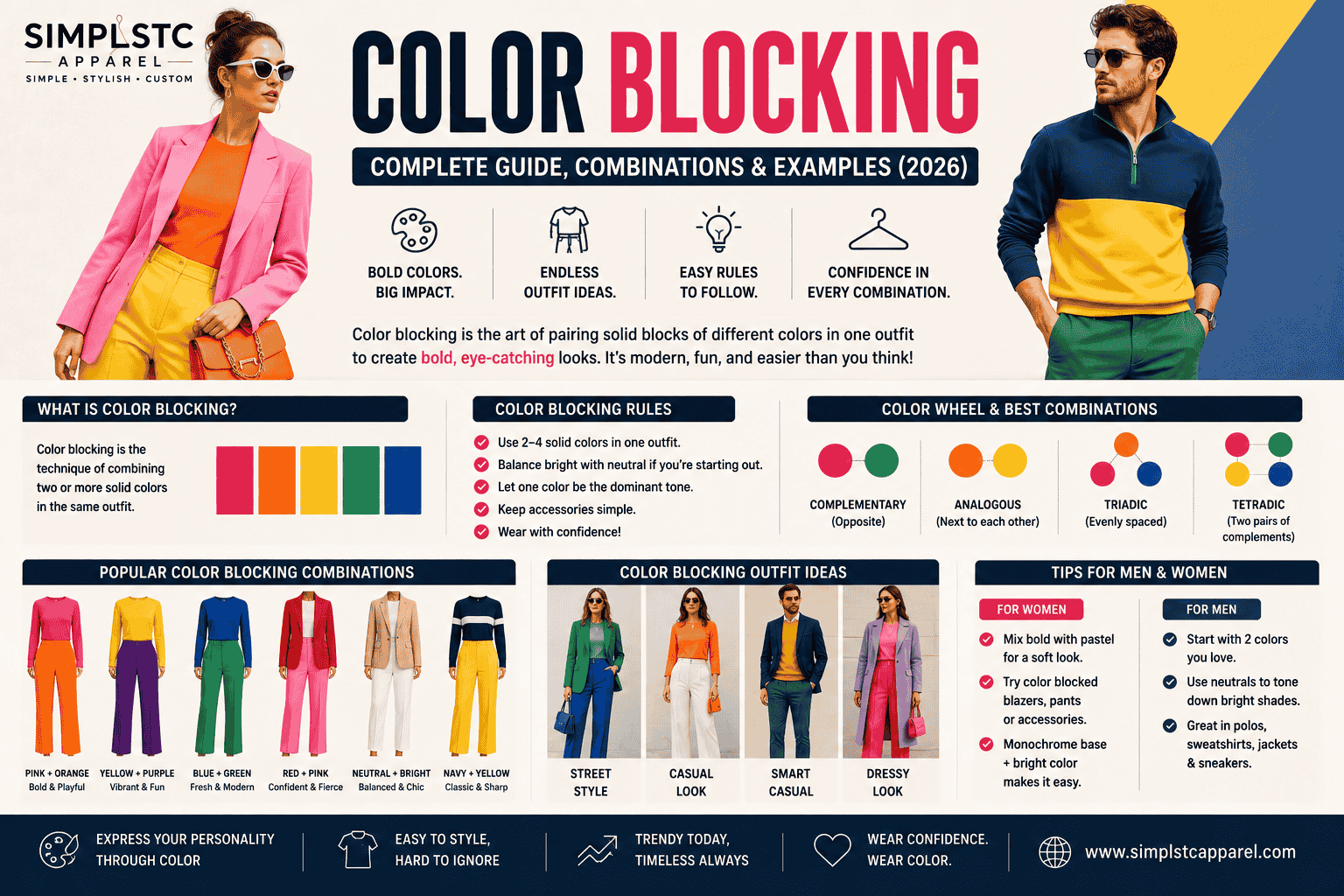
Quick answer: Color blocking is a styling technique that pairs two or more solid, contrasting colors in large, distinct sections of an outfit — rather than mixing patterns or blending tones. The easiest way to start is with complementary colors (opposite on the color wheel, like navy and orange) or a bold monochrome-plus-one-accent combination. Keep silhouettes simple and let the colors do the visual work.
Color blocking has moved from runway-only territory into one of the most accessible, high-impact styling techniques anyone can try — and it's also one of the most misunderstood. Done well, it looks confident and intentional. Done poorly, it can look like a wardrobe malfunction. The difference almost always comes down to understanding a few basic color theory rules rather than just grabbing the boldest colors in your closet.
This guide covers exactly what color blocking is, the color combinations that actually work, real examples for both men and women, and the most common mistakes that separate a polished color block outfit from one that misses the mark.
What Is Color Blocking?
Color blocking is a fashion and design technique that combines two or more solid, contrasting colors in distinct, large sections of an outfit — as opposed to patterns, prints, or gradual color blending. The technique gets its name from the visual effect of colors appearing as clean "blocks" against each other, with sharp boundaries rather than soft transitions.
The technique originated in 1960s mod fashion and fine art — most famously in Yves Saint Laurent's 1965 Mondrian dress collection, inspired directly by painter Piet Mondrian's bold geometric color-block paintings. It has cycled in and out of mainstream fashion ever since, currently enjoying a strong resurgence across both street style and workwear.
How to Color Block — The Basic Rules
-
Start with 2-3 colors maximum: color blocking loses its clean, intentional look once you go beyond three solid colors in one outfit
-
Choose colors from the same intensity level: pair two bold, saturated colors together, or two muted colors together — mixing a neon color with a pastel usually looks unbalanced
-
Keep silhouettes simple: color blocking is already visually loud; fitted, clean-lined garments let the color combination be the statement rather than competing with busy cuts or textures
-
Use a 60/30/10 ratio: one dominant color covering roughly 60% of the outfit, a secondary color at 30%, and a small accent color at 10% (shoes, bag, or accessory) creates natural visual balance
-
Break it up with a neutral: black, white, or gray shoes and accessories give the eye a resting point between two bold colors
✓ Style Tip: If you're new to color blocking, start with just two colors and one neutral (like a bold top, contrasting bottom, and white sneakers) before attempting a full three-color combination.
Color Block Combinations That Actually Work
Color block combinations that succeed almost always follow real color theory rather than random pairing. Here are the reliable relationships to build from:
|
Combination Type |
How It Works |
Example Pairing |
|
Complementary |
Colors directly opposite on the color wheel — maximum contrast |
Navy + Orange, Red + Green, Purple + Yellow |
|
Analogous |
Colors next to each other on the wheel — softer contrast |
Red + Orange + Pink, Blue + Green + Teal |
|
Triadic |
Three colors evenly spaced on the wheel |
Red + Yellow + Blue |
|
Monochrome + Accent |
Different shades of one color plus a single accent |
Navy + Light Blue + White accent |
|
Neutral + Bold |
One neutral base with a single vivid accent color |
Black + Beige + one bold red piece |
Explore these color combinations directly on real garments — browse White, Black, Navy, Red, Green, Yellow, Orange, and Pink t-shirts to build your own color block outfit.
Color Blocking for Men
Color blocking menswear has grown significantly beyond the traditional muted or monochrome male wardrobe, driven largely by streetwear culture and athletic-inspired fashion. Color blocking men's outfits typically work best with one of these approaches:
-
Layered color blocking: a solid-color t-shirt under a contrasting solid jacket or overshirt — the easiest, lowest-risk entry point for men new to the technique
-
Top-and-bottom blocking: a bold-colored shirt or tee paired with contrasting pants or shorts, unified with neutral shoes
-
Athletic-inspired blocking: drawing from retro sportswear, pairing two bold colors the way vintage tracksuits and windbreakers traditionally did
Color Blocking for Women
Colour blocking outfits for ladies span a wider range of silhouettes than menswear, from a single color-blocked dress to fully separated pieces:
-
Single-garment blocking: a dress or jumpsuit with built-in color panels — the most foolproof option since the color balance is already designed
-
Separates blocking: a solid top and solid bottom in contrasting colors, the most common and versatile color block outfit format
-
Accessory blocking: a mostly neutral outfit with one or two bold accessory pieces (bag, shoes, blazer) carrying the color contrast
Street Style Color Blocking Examples
Street style color blocking outfits tend to favor bold, high-contrast pairings and often incorporate a third neutral element to ground the look. Common street style formulas include a bright top with contrasting bottoms and neutral sneakers, an oversized jacket in one bold color over head-to-toe neutral, or fully coordinated separates in a single striking two-color combination.
The New Section — Color Wheel Reference for Outfit Building
Understanding basic color theory is the single fastest way to go from random color pairing to intentional color blocking.
|
Color |
Complementary (Opposite) |
Analogous (Neighboring) |
|
Red |
Green |
Orange, Pink |
|
Orange |
Blue |
Red, Yellow |
|
Yellow |
Purple |
Orange, Green |
|
Green |
Red |
Yellow, Blue |
|
Blue/Navy |
Orange |
Green, Purple |
|
Pink |
Green |
Red, Purple |
Use this table to quickly identify a complementary (high-contrast, bold) or analogous (softer, more subtle) pairing for any color block outfit idea you're building.
Common Color Blocking Mistakes to Avoid
-
Using too many colors at once: stick to 2-3 maximum; more than that reads as chaotic rather than intentional
-
Mixing patterns with color blocking: the technique relies on solid colors — adding stripes or prints defeats the clean-block effect
-
Ignoring proportion: two colors split exactly 50/50 often looks less intentional than a 60/40 or 70/30 dominant-and-accent split
-
Choosing colors with clashing undertones: a warm-toned red next to a cool-toned blue can look muddy; check that your chosen colors share similar warmth or coolness
Color Blocking for Team & Group Apparel
Color blocking principles apply directly to team, school, and event merchandise — a two-color program (like red and white, or navy and gray) using complementary or high-contrast color theory creates a bolder, more memorable team identity than a single-color order. Explore our wholesale color category pages to build a coordinated color block program:
Shop T-Shirts, Long Sleeve, Short Sleeve, Hoodies, Polos, Tank Tops, and Shorts to build a full color-blocked team or event program.
Custom decoration for color block programs available via screen printing, embroidery, and DTF printing from 12 pieces, no setup fee.
FAQs — Color Blocking
What is color blocking in fashion?
Color blocking is a styling technique that pairs two or more solid, contrasting colors in large, distinct sections of an outfit, creating a bold visual effect through clean color contrast rather than patterns or blending.
How do you color block an outfit?
Choose 2-3 solid colors following color theory (complementary or analogous), keep silhouettes simple, use a roughly 60/30/10 ratio between colors, and ground the look with a neutral accessory or shoe.
What colors work well together for color blocking?
Complementary colors (opposite on the color wheel, like navy and orange, or red and green) create the boldest contrast. Analogous colors (neighboring on the wheel) create a softer, more subtle color block look.
Is color blocking still in style?
Yes. Color blocking has seen a strong resurgence in both street style and workwear fashion, particularly through streetwear and athletic-inspired color pairings.
Can men do color blocking?
Yes. Color blocking menswear typically works through layered pieces (a solid tee under a contrasting jacket), top-and-bottom color pairing, or athletic-inspired retro color combinations.
What is the easiest way to start color blocking?
Start with just two colors and one neutral element — for example, a bold colored top, a contrasting bottom, and white or black shoes — before attempting a full three-color combination.
What are common color blocking mistakes?
Using too many colors at once, mixing patterns with solid color blocks, ignoring proportion (an even 50/50 split often looks less intentional), and pairing colors with clashing warm and cool undertones.
Need Help?
Get in touch with our experts.