
What Is GSM in Fabric? Complete Weight Guide + Chart
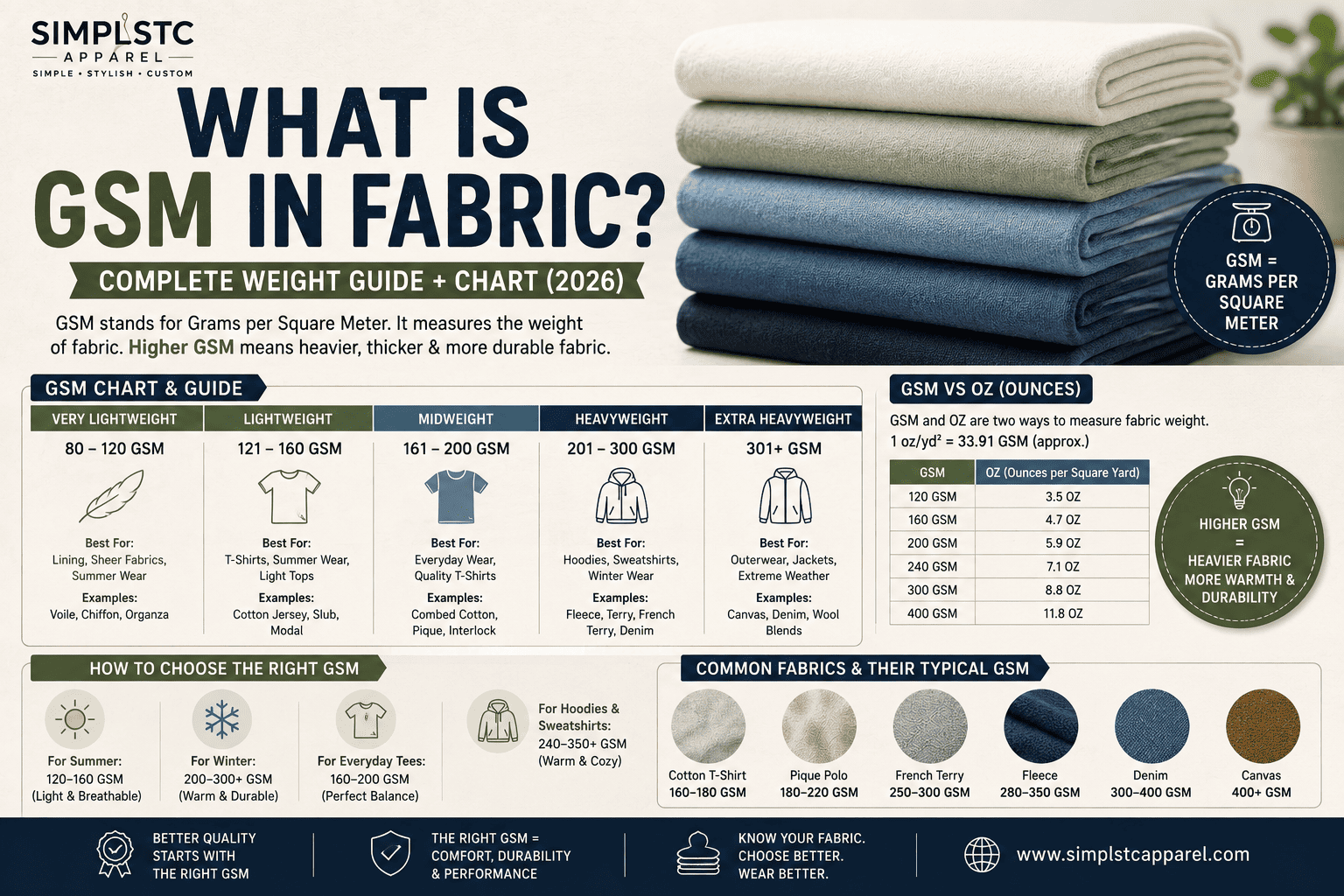
Quick answer: GSM stands for Grams per Square Meter — it's the standard unit used worldwide to measure fabric weight and density. A higher GSM means a heavier, thicker, more durable fabric; a lower GSM means a lighter, more breathable one. In clothing, GSM typically ranges from under 100 GSM (sheer, lightweight fabrics) to 300+ GSM (heavyweight hoodies and outerwear). Most standard cotton t-shirts fall between 140-200 GSM.
If you've ever picked up two t-shirts labeled "100% cotton" and wondered why one feels noticeably thicker and more substantial than the other, the answer almost always comes down to GSM. It's one of the most searched fabric terms in the apparel industry, and understanding it is genuinely useful whether you're a first-time bulk buyer trying to compare vendors, a screen printer choosing the right blank, or simply someone who wants to know what "180 GSM" actually means before ordering.
This guide covers exactly what GSM is, the full form of the acronym, how it compares to the ounce-based system used in the US, a complete GSM reference chart by garment type, and how to actually use this number to pick the right fabric for your project.
GSM Full Form and Meaning
GSM stands for Grams per Square Meter — sometimes written g/m² or gm/m². It is the international standard unit for measuring the weight and density of fabric. In practical terms, GSM tells you how much a single square meter of a given fabric weighs in grams. A higher GSM number means more fiber is packed into that square meter, producing a denser, heavier, and generally more durable fabric. A lower GSM number means less material per square meter, producing a lighter, thinner, and more breathable fabric.
GSM matters because it's the one specification that lets you compare two completely different fabrics — a cotton t-shirt and a polyester hoodie, for example — on a level, standardized basis. Explore t-shirts and hoodies at Simplstc Apparel with GSM specs listed on every product page.
How Is GSM Measured?
GSM is measured using a circular fabric sample cutter (often called a GSM cutter) that punches out a precise, standardized-area disc of fabric — typically 100 square centimeters. That sample is weighed on a precision scale, and the result is mathematically scaled up to represent the weight of a full square meter. This standardized cutting-and-weighing process is why GSM is considered a reliable, apples-to-apples comparison across different fabric mills and manufacturers, unlike more subjective descriptions like "lightweight" or "heavy-duty."
GSM vs Ounces (oz) — Converting Between the Two Systems
The United States primarily uses ounces per square yard (oz/yd²) to describe fabric weight, while most of the rest of the world — including fabric mills in Asia and Europe — uses GSM. Both measure the same underlying property (fabric density), just in different units, and converting between them is straightforward.
|
GSM |
Ounces (oz/yd²) |
Approximate Category |
|
100 GSM |
~3.0 oz |
Very lightweight |
|
135 GSM |
~4.0 oz |
Lightweight |
|
150 GSM |
~4.5 oz |
Light-medium |
|
180 GSM |
~5.3 oz |
Medium (standard t-shirt) |
|
200 GSM |
~5.9 oz |
Medium-heavy |
|
220 GSM |
~6.5 oz |
Heavy t-shirt / light fleece |
|
270 GSM |
~8.0 oz |
Midweight fleece/hoodie |
|
340 GSM |
~10.0 oz |
Heavyweight hoodie/sweatshirt |
|
400 GSM+ |
~11.8 oz+ |
Heavy outerwear/canvas |
The conversion formula: GSM ÷ 33.906 = oz/yd², or oz/yd² × 33.906 = GSM. So a common "5.3oz" t-shirt fabric converts to roughly 180 GSM, and a "10oz" heavyweight hoodie fleece converts to roughly 340 GSM — this is exactly why you'll see both numbers used interchangeably across product listings, and why "340 gsm means" and "150 gsm fabric" are both common searches from buyers trying to translate one system into the other.
GSM Chart — What Each Weight Range Means
|
GSM Range |
Category |
Typical Uses |
|
Under 100 GSM |
Ultralight |
Sheer linings, mesh, lightweight athletic wear |
|
100-150 GSM |
Lightweight |
Summer tees, moisture-wicking performance shirts |
|
150-180 GSM |
Light-Medium |
Standard budget t-shirts, tank tops |
|
180-220 GSM |
Medium |
Premium t-shirts, polos, most everyday cotton tees |
|
220-280 GSM |
Medium-Heavy |
Heavier t-shirts, lightweight sweatshirts |
|
280-340 GSM |
Heavy |
Standard hoodies, crewneck sweatshirts |
|
340-400 GSM |
Heavyweight |
Premium hoodies, workwear shirts |
|
400+ GSM |
Ultra-Heavy |
Canvas jackets, heavy outerwear, duck canvas workwear |
✓ Buyer Tip: If a product listing only shows GSM and you're used to thinking in ounces (or vice versa), use the 33.9 conversion factor above — it's the single most useful number to remember when comparing fabric specs across different suppliers.
Which GSM Fabric Is Good? Choosing the Right Weight
There's no single 'best' GSM — the right weight depends entirely on what the garment needs to do. A 150 GSM tee that's perfect for a summer 5K would feel flimsy as a screen-printed event shirt meant to last years.
-
Athletic/performance wear: 100-150 GSM polyester — lightweight and breathable for moisture-wicking during exercise
-
Everyday casual t-shirts: 160-200 GSM cotton — the sweet spot most buyers actually want, balancing softness with enough structure to hold its shape
-
Screen printing/embroidery blanks: 180-220 GSM — heavy enough to prevent show-through and hold stitching without being stiff
-
Hoodies and sweatshirts: 280-340 GSM — enough weight for warmth and durability through repeated wear and washing
-
Workwear and heavy-duty apparel: 400+ GSM — maximum durability for job-site abrasion resistance
GSM in Cotton — What Makes 100% Cotton GSM Different
Cotton GSM behaves somewhat differently than synthetic fabric GSM because cotton fiber itself has natural weight and texture variation depending on how it's spun and woven. Ring-spun and combed cotton — used in premium blanks like Bella+Canvas — can achieve a softer hand-feel at a lower GSM than standard carded cotton, meaning a 160 GSM ring-spun tee can feel just as substantial as a 180 GSM standard cotton tee. This is why GSM alone doesn't tell the whole story about fabric quality — the type of cotton and how it's spun matters just as much as the raw weight number.
Garment-dyed cotton, used by brands like Comfort Colors, also tends to run on the heavier end (200+ GSM) because the dyeing process itself is easier to control on a more substantial fabric base, which is part of why garment-dyed tees have their signature substantial, lived-in feel.
The New Section — GSM by Garment Type: Real Brand Examples
Rather than abstract ranges, here's how GSM plays out across actual wholesale styles — useful for translating a spec sheet into what you'll actually feel in your hands.
|
Garment |
Approx. GSM |
Example |
|
Budget cotton tee |
180 GSM (5.3oz) |
Gildan 5000 Heavy Cotton Tee |
|
Premium ring-spun tee |
150-160 GSM |
Bella+Canvas 3001 |
|
Garment-dyed heavyweight tee |
220+ GSM |
Comfort Colors 1717 |
|
Athletic performance tee |
135-150 GSM |
Sport-Tek ST350 |
|
Standard hooded sweatshirt |
280 GSM (8oz) |
Gildan 18500 |
|
Heavyweight duck canvas jacket |
400+ GSM |
Carhartt workwear |
|
Budget bulk tee |
150 GSM (4.5oz) |
Hanes 5250 |
Explore these real GSM examples across Gildan, Bella+Canvas, Comfort Colors, Sport-Tek, Hanes, and Carhartt at Simplstc Apparel.
Does Higher GSM Always Mean Better Quality?
No — this is the single most common misconception about GSM, and it's worth addressing directly.
GSM measures weight and density, not quality. A heavier fabric isn't automatically a better one — it's simply denser. Fiber type, yarn quality (ring-spun vs. carded, combed vs. uncombed), weave or knit construction, and finishing all affect how a fabric feels, breathes, and performs, independent of its raw GSM number. A well-made 150 GSM premium cotton tee can genuinely outperform a poorly constructed 220 GSM budget tee in softness, durability, and overall feel. Use GSM as one data point among several — not the only factor — when evaluating fabric quality.
Wholesale Fabric Weight Guide by Program Type
|
Program Type |
Recommended GSM |
Why |
|
School/event fundraiser tees |
150-180 GSM |
Budget-friendly, still holds a print well |
|
Corporate polos/embroidered shirts |
200-220 GSM |
Structured enough for clean stitching |
|
Athletic team jerseys |
120-150 GSM poly |
Lightweight, moisture-wicking performance |
|
Retail/boutique premium tees |
150-160 GSM ring-spun |
Soft hand-feel that justifies a higher price point |
|
Winter corporate gifting (hoodies) |
280-340 GSM |
Genuine warmth and durability |
|
Workwear/job-site apparel |
350+ GSM |
Maximum abrasion resistance |
Explore cotton t-shirts, performance t-shirts, sweatshirts, polos, outerwear, and workwear at Simplstc Apparel — GSM listed on every product.
Custom decoration available via screen printing, embroidery, and DTF printing from 12 pieces, no setup fee.
FAQs — What Is GSM in Fabric
What does GSM stand for?
GSM stands for Grams per Square Meter — the international standard unit for measuring fabric weight and density.
What is a good GSM for a t-shirt?
180-220 GSM is the sweet spot for most everyday cotton t-shirts, balancing softness with enough structure to print or embroider on and hold its shape through washing.
What does 350 GSM mean?
350 GSM means a square meter of that fabric weighs 350 grams — placing it in the heavyweight category, typical of premium hoodies, sweatshirts, and workwear-grade fabric.
How do I convert GSM to ounces?
Divide GSM by 33.906 to get ounces per square yard. For example, 180 GSM ÷ 33.906 ≈ 5.3 oz, the standard weight for a classic cotton t-shirt.
Is higher GSM always better quality?
No. GSM measures weight and density, not quality. Fiber type, yarn spinning method, and construction all affect quality independently of the raw GSM number.
What GSM is best for hoodies?
280-340 GSM is the standard range for hoodies and sweatshirts, providing genuine warmth and durability through repeated wear and washing.
What is GSM in cotton specifically?
GSM in cotton measures the same grams-per-square-meter density as any fabric, but cotton quality also depends heavily on whether it's ring-spun, combed, or standard carded cotton — two cottons at the same GSM can feel very different.

Need Help?
Get in touch with our experts.