What Is Ring Spun Cotton? Open-End vs Ring-Spun vs Combed Ring-Spun — Complete Guide
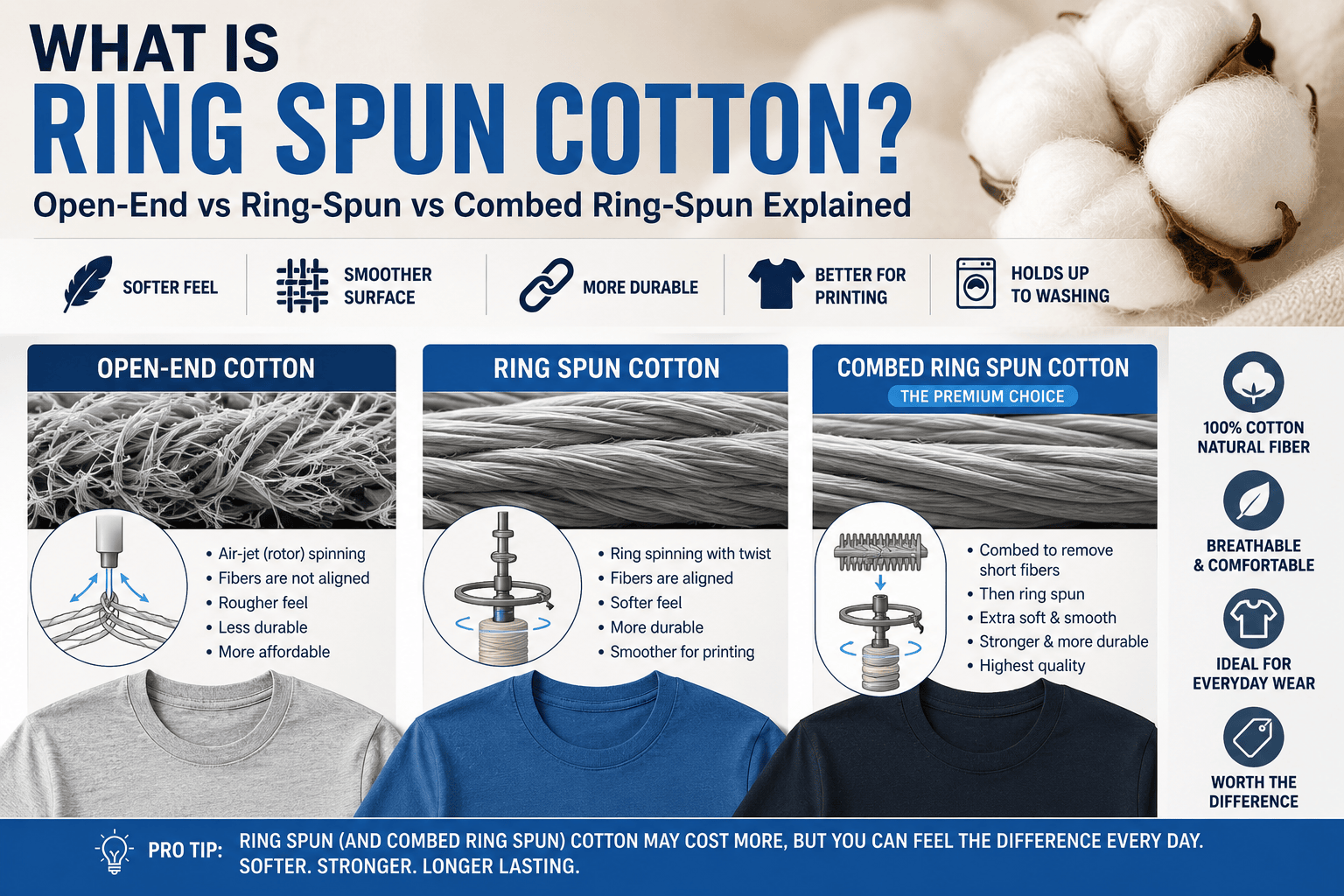
Quick answer: Ring spun cotton is cotton yarn produced by continuously twisting and thinning cotton fibers during spinning — creating a stronger, finer, and softer yarn than open-end (air-jet) spun cotton. The twisting process aligns fibers parallel to each other, removing irregular short fibers and producing a smoother, more uniform yarn. Ring spun cotton t-shirts are noticeably softer, more durable, and have a smoother surface than standard open-end cotton shirts.
If you've picked up a premium t-shirt at a lifestyle brand, a boutique, or a higher-end gym program and noticed it felt dramatically softer and more refined than the basic event shirt sitting next to it, ring spun cotton is almost certainly why. The difference is not in the cotton fiber itself — it's in how the fiber is spun into yarn. That manufacturing step determines everything about how the finished t-shirt feels against skin.
This guide explains exactly what ring spun cotton is, how it's made, how it compares to open-end and combed ring spun cotton, whether it shrinks, why it costs more, and which ring spun wholesale blanks are right for every program type.
What Is Ring Spun Cotton? — The Manufacturing Process Explained
To understand ring spun cotton, you need to understand the two main ways cotton fibers are spun into yarn: ring spinning and open-end (air-jet) spinning. The yarn-making process is where the quality difference is created — before knitting, weaving, or finishing.
Step 1: Where All Cotton Starts — Fiber Preparation
Cotton starts as raw fiber harvested from cotton bolls. After harvest, the fibers go through a series of cleaning and alignment steps: ginning (separating fiber from seed), carding (disentangling and aligning fibers into a loose rope called a sliver), and sometimes combing (removing short fibers — more on this in the combed ring spun section).
At this point, both ring spun and open-end cotton start with the same raw material — cleaned, carded cotton sliver. The difference happens in the spinning step.
Step 2A: Ring Spinning — The Method That Produces Ring Spun Cotton
In ring spinning, the cotton sliver is fed through a series of drafting rollers that progressively thin and stretch it. As the thinned fiber strand exits the rollers, it passes through a small ring with a rotating traveler (a small metal clip that rides around the ring). The rotating traveler twists the fiber strand as it is wound onto a bobbin — this continuous twisting under tension is what defines ring spinning.
The ring spinning mechanism produces several specific effects on the yarn:
-
Fiber alignment: the constant tension and twist during ring spinning aligns cotton fibers parallel to the yarn axis — long fibers are incorporated efficiently; short fibers fall away or are held down against the yarn surface
-
Finer yarn diameter: the drafting and twisting process produces a finer, more uniform yarn diameter than open-end spinning at comparable fiber counts
-
Higher strength: the fiber-to-fiber contact in a tightly twisted ring spun yarn is greater than in an open-end yarn — producing stronger yarn that is more resistant to pilling and wear
-
Smoother surface: aligned fibers mean fewer fiber ends protruding from the yarn surface — resulting in a smoother yarn that produces a smoother fabric surface
Step 2B: Open-End Spinning — What Standard Cotton T-Shirts Use
Open-end spinning (also called air-jet spinning or rotor spinning) is a higher-speed, lower-cost alternative to ring spinning. In open-end spinning, the cotton sliver is fed into a rapidly rotating rotor. Centrifugal force throws the fibers against the rotor wall, where they are collected and twisted into yarn.
Open-end spinning is approximately 5–8 times faster than ring spinning — which is why open-end cotton yarn is significantly less expensive to produce. But the speed comes with trade-offs:
-
Less fiber alignment: fibers are incorporated into the yarn at random orientations rather than parallel alignment — producing a bulkier, less uniform yarn
-
Coarser feel: more fiber ends protrude from the yarn surface — producing a slightly rougher, scratchier fabric surface
-
Lower strength at fine count: open-end yarns are less strong at fine counts than ring spun — which is why very lightweight t-shirts use ring spun cotton
-
Better for heavyweights: open-end cotton is actually appropriate for heavier-weight fabrics where softness is less critical — the Gildan 5000 at 5.3oz uses open-end cotton that is excellent for its purpose
Key takeaway: both ring spun and open-end cotton are 100% cotton — the difference is not in the fiber type but in HOW the fiber is twisted into yarn. Ring spinning = finer, stronger, softer yarn. Open-end spinning = faster, cheaper, slightly coarser yarn.
What Is Combed Ring Spun Cotton? — The Premium Tier
Combed ring spun cotton is the premium tier of cotton yarn — it adds an additional combing step BEFORE ring spinning that removes all short fibers, leaving only the longest, finest cotton fibers to be ring spun into yarn. The result is the softest, smoothest, most uniform cotton yarn available at commercial scale.
The combing step makes a significant difference:
-
Short fiber removal: combing removes fibers shorter than approximately 0.75 inches — these short fibers are what cause roughness and pilling in standard cotton fabrics. Removing them leaves only long fibers for spinning.
-
Further alignment: combing straightens remaining fibers more completely than carding alone — the fibers entering the ring spinning step are more parallel and more uniform
-
Higher quality but more waste: combing removes 10–25% of the total fiber as short-fiber waste — this is part of why combed ring spun cotton costs more; more raw fiber is consumed per unit of finished yarn
-
Ultra-smooth surface: the long, parallel fibers produce very few protruding fiber ends in the final yarn and fabric — the hallmark smoothness of premium combed ring spun tees
The Bella+Canvas 3001 Airlume combed and ring spun cotton is the most popular combed ring spun wholesale t-shirt blank — and the ultra-soft hand-feel that makes it worth $6+ per unit versus $2.50 for a Gildan 5000 is entirely attributable to the combing step before ring spinning.
Ring Spun vs Open-End vs Combed Ring Spun — The Complete Comparison
|
Property |
Open-End Cotton |
Ring Spun Cotton |
Combed Ring Spun Cotton |
|
Spinning method |
Air-jet / rotor spinning |
Ring spinning with traveler |
Combing + ring spinning |
|
Pre-spinning step |
Carding only |
Carding + ring spinning |
Carding + combing + ring spinning |
|
Short fibers removed? |
No |
Some (by spinning tension) |
Yes — combing removes 10–25% |
|
Fiber alignment |
Random — inconsistent direction |
Good — generally parallel |
Excellent — highly uniform and parallel |
|
Yarn smoothness |
Rougher — protruding fiber ends |
Smooth — fewer protruding ends |
Ultra-smooth — minimal fiber ends |
|
Fabric hand-feel |
Standard — slightly rough |
Noticeably softer than open-end |
Premium soft — the softest standard cotton |
|
Pilling resistance |
Lower — loose fibers pill over time |
Good — aligned fibers resist pilling |
Excellent — long fibers stay aligned |
|
Fabric weight range |
Heavy (5–7oz) most common |
Medium-Light (4–5.5oz) most common |
Light (3.5–5oz) most common |
|
Production speed |
Fastest — 5–8x ring spinning |
Moderate |
Slowest — adds combing step |
|
Cost |
Lowest |
Moderate |
Highest |
|
Best wholesale blank |
Gildan 5000 (5.3oz open-end) |
Gildan 64000 Softstyle (4.5oz ring spun) |
Bella+Canvas 3001 (4.2oz combed ring spun) |
|
Starting wholesale price |
~$2.50/unit |
~$3.50/unit |
~$5.50–$7/unit |
|
Best program |
Events, schools, high-volume bulk |
Lifestyle, school spirit, mid-range |
Premium retail, lifestyle brands, boutique |
What Does Ring Spun Cotton Mean? — Practical Buyer's Explanation
When you see '100% ring spun cotton' on a t-shirt label or product description, it tells you three specific things about that shirt compared to a standard open-end cotton shirt:
-
Softer hand-feel: the aligned fiber construction and smoother yarn surface translate directly to a softer feel against the skin. Picked up a ring spun tee next to a standard cotton tee — the difference is immediate and obvious.
-
Smoother surface: ring spun cotton has a cleaner, more refined surface appearance — it doesn't have the slightly rough, pill-prone surface of cheaper open-end cotton fabrics. This matters both for how it looks and for how printed designs sit on the surface.
-
Better durability: the tighter, more aligned fiber structure of ring spun cotton produces a stronger yarn that resists pilling and wear better than open-end cotton — ring spun shirts maintain their quality appearance through more wash cycles.
Ring spun cotton does NOT mean:
-
A different type of cotton fiber — it's still cotton, just processed differently
-
Necessarily organic or sustainable — ring spinning is a mechanical process independent of whether the cotton is organic
-
Combed ring spun — ring spun and combed ring spun are different; combed ring spun has the additional combing step that ring spun without combing does not
Does Ring Spun Cotton Shrink?
Yes, ring spun cotton shrinks — but the amount and timing depends on whether it is pre-shrunk during production. Untreated ring spun cotton shrinks 3–7% in the first wash. Pre-shrunk ring spun cotton (the standard in wholesale blanks) shrinks 1–3% total. Combed ring spun cotton behaves the same way.
Ring spun cotton shrinks for the same reason all cotton shrinks: water breaks the hydrogen bonds in the cellulose fibers, allowing them to relax and contract from the tension applied during spinning, knitting, and finishing. The finer yarn of ring spun cotton does not make it more or less prone to shrinkage than open-end cotton — shrinkage is a property of cotton fiber in general, not of the spinning method.
Pre-Shrunk vs Non-Pre-Shrunk Ring Spun Cotton
Most wholesale ring spun cotton t-shirts are pre-shrunk during production — the fabric is washed and dried under controlled conditions before cutting and sewing, forcing most of the potential shrinkage to occur before the shirt is made. This dramatically reduces shrinkage during the customer's use:
-
Pre-shrunk ring spun cotton (Gildan 64000, Bella+Canvas 3001): 1–3% total shrinkage; most shrinkage has already occurred during production
-
Non-pre-shrunk ring spun cotton: 3–7% shrinkage in first wash; continues to shrink gradually over subsequent washes
-
How to minimize shrinkage in pre-shrunk cotton: wash cold, dry on low heat or air dry. Cold washing removes nearly all wash-cycle shrinkage risk; low heat in the dryer is safer than high heat
✓ Pro Tip: For wholesale programs ordering ring spun cotton shirts that will be custom decorated — always wash a sample before printing to account for any residual shrinkage. Print the shirt after pre-washing for the most accurate fit in the customer's hands.
Does Combed Ring Spun Cotton Shrink?
Combed ring spun cotton shrinks at the same rate as standard ring spun cotton — the combing step removes short fibers but does not change the fundamental behavior of cotton cellulose fibers when exposed to water and heat. Pre-shrunk combed ring spun cotton (Bella+Canvas 3001 Airlume) shrinks 1–3% total. The care instructions are the same: cold wash, low heat dry.
Is Ring Spun Cotton Good? — Who Should Use It and When
Ring spun cotton is better than open-end cotton for hand-feel, surface quality, and durability — but 'better' depends on the program's priorities. Open-end cotton is better for cost and for very high-volume programs where per-unit price is the primary driver.
Ring Spun Cotton Is the Right Choice When
-
The shirt will be worn casually and comfort matters: ring spun cotton's softer hand-feel is noticeable in daily casual wear — recipients are more likely to choose a ring spun shirt over other shirts in their drawer
-
The program positions the shirt as a quality item: ring spun cotton communicates care about the garment quality; appropriate for premium event shirts, branded merchandise people are expected to wear regularly
-
Screen printing or DTF design quality matters: the smoother surface of ring spun cotton produces cleaner, sharper print edges than open-end cotton — important for detailed graphics and fine text
-
The garment is for retail or boutique sale: at any retail price point above $20, ring spun cotton is the minimum expected quality
-
Recipients will judge the shirt quality: for corporate gifting, where the shirt's quality reflects on the company, ring spun provides the appropriate quality level
Open-End Cotton May Be the Better Choice When
-
Maximum quantity within a tight budget: for school events, community giveaways, and mass promotional programs where the primary goal is distributing shirts affordably, open-end cotton (Gildan 5000) is the correct economic choice
-
Heavy-weight durability is more important than softness: construction crews, outdoor work programs, and heavy-use scenarios benefit from the heavier open-end cotton construction
-
High-volume screen printing programs: open-end cotton's slightly rougher surface absorbs plastisol screen printing ink very consistently — the Gildan 5000 is the most popular screen printing substrate in the world for this reason
Ring Spun Cotton vs Other Cotton Types — Complete Reference
|
Cotton Type |
What It Is |
Hand Feel |
Best For |
Top Blank |
|
Open-End Cotton |
Standard yarn spinning — fastest, cheapest |
Standard — functional |
Events, bulk promotional, workwear |
Gildan 5000 Heavy Cotton |
|
Ring Spun Cotton |
Twist-aligned finer yarn |
Noticeably softer |
Lifestyle, school spirit, corporate casual |
Gildan 64000 Softstyle |
|
Combed Ring Spun Cotton |
Combed + ring spun — finest yarn |
Premium ultra-soft |
Boutique retail, lifestyle brands, premium gifts |
Bella+Canvas 3001 Airlume |
|
Pima Cotton |
Extra-long staple fiber |
Silky, luxurious |
Luxury retail programs |
Select premium brands |
|
Garment-Dyed Cotton |
Dyed after construction — any spin type |
Soft with worn texture |
Vintage lifestyle brands |
Comfort Colors 1717 |
|
Organic Cotton |
GOTS-certified, no synthetic pesticides |
Similar to conventional cotton |
Eco-conscious brands |
Allmade AL2100 |
|
Made in USA Cotton |
American-grown, domestic mill |
Varies — ring spun available |
Heritage, patriotic, union programs |
Volunteer Knitwear VL100 |
Ring Spun Cotton T-Shirts — Best Wholesale Blanks
Ring Spun Cotton (Without Combing)
Gildan 64000 Softstyle — 4.5oz ring spun cotton; the most ordered mid-range wholesale ring spun blank; noticeably softer than the Gildan 5000; starting ~$3.50/unit. Available in 30+ colors. Perfect for school spirit, corporate casual, and any program stepping up from basic cotton. Explore Gildan at Simplstc Apparel.
Next Level Apparel 3600 — 4.3oz ring spun cotton; premium soft-hand ring spun at a lower price point than Bella+Canvas; a strong middle-ground option between Gildan 64000 and Bella+Canvas 3001. Explore Next Level Apparel.
Combed Ring Spun Cotton
Bella+Canvas 3001 Airlume — 4.2oz 100% Airlume combed and ring spun cotton; the most popular combed ring spun wholesale blank; ultra-smooth surface; 100+ colors available; the standard for lifestyle brands, boutique retail, and premium decorated programs. Starting ~$6/unit. Explore Bella+Canvas at Simplstc Apparel.
Next Level Apparel 3710 — soft combed ring spun blend; alternative to Bella+Canvas 3001 at a slightly lower price point with comparable softness.
Allmade AL2100 — GOTS-certified 100% organic combed ring spun cotton; for sustainable brand programs needing the combed ring spun softness with certified organic credentials. Explore Allmade at Simplstc Apparel.
Garment-Dyed Ring Spun Cotton
Comfort Colors 1717 — 6.1oz 100% ring spun cotton, garment-dyed; the dominant blank for vintage and lifestyle programs; ring spun construction with the washed, muted colorways of garment dyeing. The most distinctive wholesale blank in the lifestyle brand market. Explore Comfort Colors at Simplstc Apparel.
Ring Spun Cotton for Printing — What Decorators Need to Know
The smoother surface of ring spun cotton produces better print results than open-end cotton in most decoration methods:
-
Screen printing: ring spun cotton produces sharper print edges and cleaner color reproduction than open-end cotton. The smoother yarn surface allows ink to sit more consistently — less variation in ink absorption across the fabric surface. Screen printing services at Simplstc Apparel.
-
DTF printing: DTF transfers adhere more consistently and peel more cleanly on ring spun and combed ring spun cotton — the uniform surface provides better transfer adhesion. DTF printing services at Simplstc Apparel.
-
DTG printing: combed ring spun cotton is the gold standard for DTG (direct-to-garment) printing — the ultra-smooth uniform surface provides the best ink penetration and the most vibrant DTG results. Open-end cotton produces less vibrant DTG results on the same printer.
-
Embroidery: ring spun cotton's stronger yarn structure holds embroidery better than open-end cotton — fewer broken yarns during hooping and stitching. Embroidery services at Simplstc Apparel.
✓ Pro Tip: For the best screen printing results: Gildan 64000 Softstyle ring spun cotton is the best value screen printing blank for programs stepping up from Gildan 5000 — it accepts plastisol ink consistently while providing noticeably better hand-feel at a modest price increase.
What Is Ring Spun Cotton Towels? — Non-Apparel Applications
Ring spun cotton is not exclusive to apparel — 'ring spun cotton' appears on bath towels, t-shirt quilts, bed sheets, and other textile products for the same reason it appears on t-shirts: the ring spinning process produces a finer, stronger, softer yarn that benefits every textile application.
Ring spun cotton towels have several specific advantages over standard cotton terry towels:
-
More absorbent per unit weight: the finer yarn allows more surface area for water absorption — ring spun towels absorb water as effectively as heavier open-end towels at a lower weight
-
Softer feel: the same softer hand-feel advantage of ring spun cotton in apparel applies to towels — ring spun cotton towels feel noticeably softer and more premium than standard cotton terry
-
Better durability through washing: ring spun yarn maintains its integrity through more wash cycles than open-end cotton — particularly important for towels that are washed frequently
-
Higher retail price support: ring spun cotton towels and bed sheets command premium retail pricing in the home goods market — the same quality signal applies across textile categories
While Simplstc Apparel focuses on wholesale apparel rather than home textiles, the ring spun cotton quality principle applies identically — in every textile category, ring spun cotton means the same thing: softer, stronger, smoother than standard cotton.
The New Section — How to Read a Cotton T-Shirt Label: Ring Spun, Combed Ring Spun & What It Really Means
T-shirt labels use specific terminology that has precise meaning for quality. Here is the complete guide to decoding cotton t-shirt label language — so you always know exactly what you're getting before you order.
|
Label Language |
What It Actually Means |
Quality Tier |
Example Blank |
|
100% Cotton |
Cotton fiber — spinning method not specified; typically open-end in budget blanks |
Standard |
Gildan 5000, Hanes Beefy-T |
|
100% Ring Spun Cotton |
Cotton fiber + ring spinning process; softer than standard cotton |
Mid-range |
Gildan 64000, Next Level 3600 |
|
100% Combed Ring Spun Cotton |
Cotton fiber + combing + ring spinning; softest standard cotton |
Premium |
Most Bella+Canvas, Next Level premium |
|
Airlume Combed & Ring Spun |
Bella+Canvas trademark for their specific combed ring spun cotton process |
Premium (branded) |
Bella+Canvas 3001 |
|
Garment Dyed |
Dyed after construction — softens the cotton; spinning type separate |
Specialty |
Comfort Colors 1717 |
|
Pre-Shrunk |
Shrunk during production to reduce consumer shrinkage — applies to any spinning type |
Standard practice |
Most wholesale blanks |
|
100% GOTS Organic Cotton |
Certified organic fiber; GOTS audits full supply chain — spinning type separate |
Eco-premium |
Allmade AL2100 |
|
Ring Spun & Combed (order matters) |
Same as combed ring spun — some brands list in different order |
Premium |
Various premium blanks |
|
Pima / Supima Cotton |
Extra-long staple cotton fiber — a fiber quality claim, not a spinning method claim |
Luxury |
Select premium brands |
|
Made in USA |
Manufacturing claim; does not specify fiber type or spinning method independently |
Heritage / patriotic |
Volunteer Knitwear VL100 |
The most important label distinction for wholesale buyers: '100% cotton' without specifying ring spun is almost always open-end cotton. '100% ring spun cotton' specifies the spinning method and guarantees the softer hand-feel. '100% combed ring spun cotton' or 'Airlume combed and ring spun' specifies the highest standard of cotton processing available at commercial scale.
FAQs
What is ring spun cotton?
Ring spun cotton is cotton yarn produced by the ring spinning process — continuously twisting and thinning cotton fibers under tension to create a finer, stronger, and softer yarn than open-end (air-jet) spun cotton. The twisting aligns fibers parallel to each other, producing a smoother yarn with fewer protruding fiber ends, resulting in a noticeably softer fabric surface than standard open-end cotton.
What does ring spun cotton mean on a t-shirt?
On a t-shirt label, 'ring spun cotton' means the shirt uses a yarn made by the ring spinning process — producing a fabric that is noticeably softer, smoother, and more durable than a standard cotton shirt made with open-end (air-jet) spun yarn. Ring spun cotton t-shirts feel softer against the skin and maintain their quality through more wash cycles.
What is the difference between ring spun and combed ring spun cotton?
Ring spun cotton undergoes the ring spinning process only — fibers are twisted and aligned but short fibers are not pre-removed. Combed ring spun cotton adds a combing step before spinning that removes all short fibers (10–25% of the total fiber is removed as waste), leaving only long fibers for spinning. Combed ring spun cotton produces an even softer, smoother, more uniform fabric than standard ring spun cotton.
Does ring spun cotton shrink?
Yes, ring spun cotton shrinks — cotton fiber shrinks when exposed to water and heat regardless of the spinning method. Most wholesale ring spun cotton blanks are pre-shrunk during production, limiting total shrinkage to 1–3%. To minimize shrinkage: wash in cold water and dry on low heat or air dry. The Gildan 64000 and Bella+Canvas 3001 are both pre-shrunk.
Is ring spun cotton good?
Yes — ring spun cotton is better than standard open-end cotton in hand-feel, surface quality, print clarity, and durability. Whether it's the 'right' choice depends on the program: ring spun is ideal for lifestyle retail, premium programs, and shirts people will choose to wear regularly. Open-end cotton remains the better choice for high-volume budget programs where cost is the primary driver.
What is 100% ring spun cotton?
100% ring spun cotton means the shirt fabric is made entirely from cotton fiber (no synthetic content) processed through the ring spinning method. Both '100% ring spun cotton' and '100% combed ring spun cotton' describe 100% cotton shirts — the difference is whether the additional combing step was applied before spinning.
What is the softest wholesale ring spun cotton t-shirt?
The Bella+Canvas 3001 Airlume combed and ring spun cotton t-shirt is the softest widely-available wholesale blank — using both combing and ring spinning to produce the finest, most uniform cotton yarn at commercial wholesale pricing. The Next Level Apparel 3600 and 3610 are close alternatives at a slightly lower price point.
Where can I buy wholesale ring spun cotton t-shirts?
Simplstc Apparel carries wholesale ring spun cotton t-shirts from Gildan (Softstyle 64000), Bella+Canvas (3001 Airlume combed ring spun), Comfort Colors (1717 garment-dyed ring spun), Next Level Apparel, and Allmade — all available blank or custom-decorated from 12 pieces with no setup fee. Free shipping over $149.99.


Need Help?
Get in touch with our experts.