What Is a Dry Fit Shirt? Dri-FIT Meaning, Material & How Moisture-Wicking Works
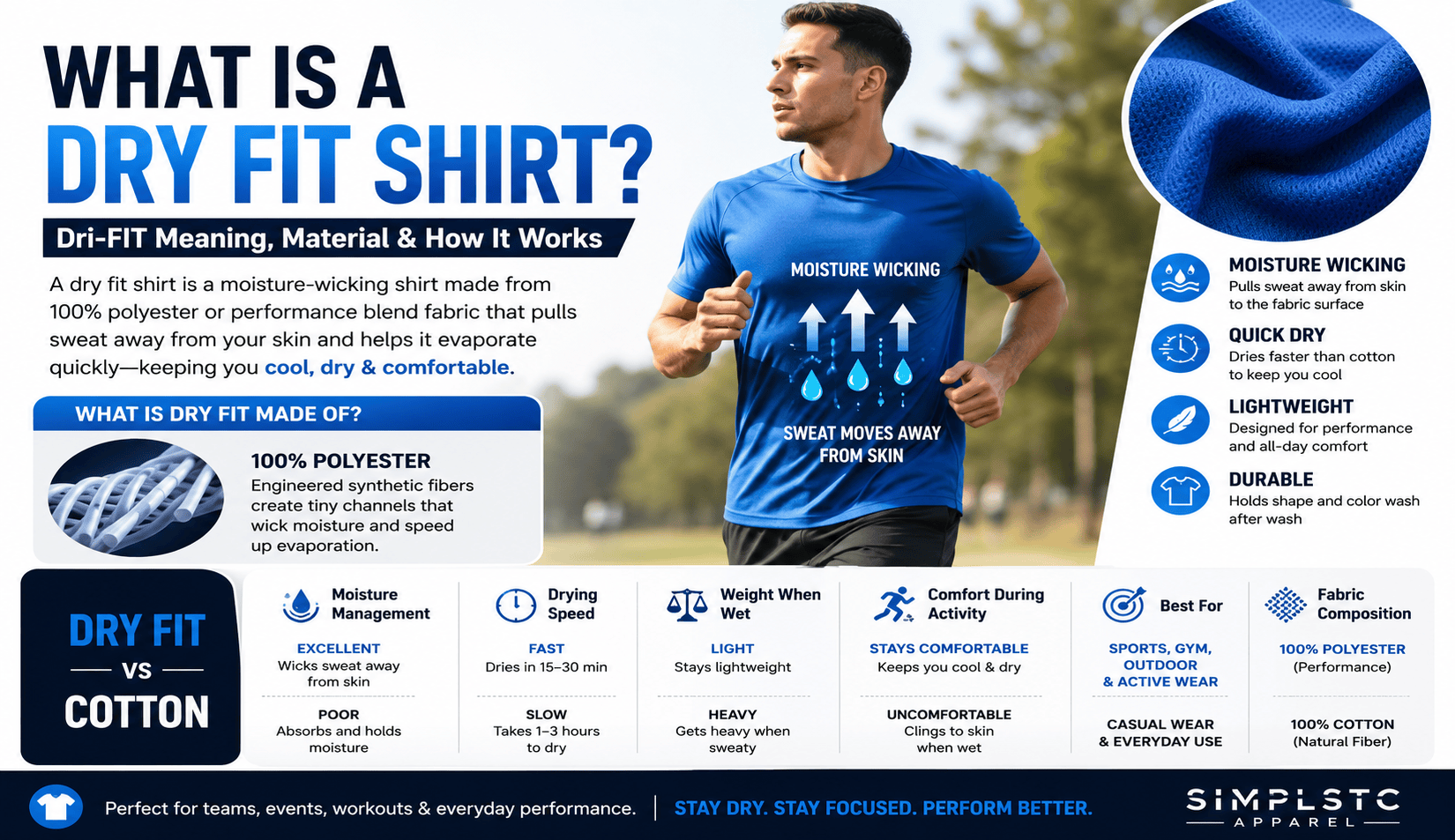
Quick answer: A dry fit shirt is a moisture-wicking athletic shirt made from 100% polyester or a polyester-blend fabric engineered to pull sweat away from the skin and push it to the fabric surface where it evaporates quickly. 'Dri-FIT' is Nike's trademarked brand name for their specific moisture-wicking polyester technology — but the term 'dry fit' is now widely used as a generic description for any moisture-wicking performance shirt regardless of brand.
You've seen them on every athletic field, every gym floor, and every school track program. The term 'dry fit shirt' gets used constantly — but understanding what it actually means, what it's made of, and why it performs so differently from a cotton t-shirt during exercise makes it much easier to choose the right shirt for athletic programs, team uniforms, and performance merchandise.
This guide covers everything: what dry fit material is and how it's made, the science of how moisture-wicking works, the difference between Dri-FIT and dry blend, how dry fit shirts compare to cotton, care instructions, and how to choose the right performance shirt for every wholesale athletic program.
What Does Dry Fit Mean?
'Dry fit' is a generic, widely-used term for moisture-wicking performance shirts — shirts made from synthetic fabrics (primarily polyester) that move sweat from the skin surface to the outer surface of the fabric, where it evaporates rapidly. The term originated from Nike's Dri-FIT trademark but has become the common noun for any performance athletic shirt regardless of brand or specific technology.
When you see 'dry fit' or 'dri fit' on a shirt label or product description, it means:
-
Moisture wicking: the fabric actively moves sweat away from your skin through capillary action in the fabric fibers
-
Quick drying: the fabric dries significantly faster than cotton — sweat that reaches the outer surface evaporates in minutes rather than hours
-
Lightweight: performance polyester fabrics are typically 3–5oz — lighter than most cotton t-shirts
-
Stretch: many dry fit fabrics include spandex or elastane for 4-way stretch and freedom of movement
-
Color retention: polyester holds dye better than cotton through repeated washing — team uniform colors remain vibrant for a full season
What Is Dry Fit Made Of? — The Material Science
The Primary Material: Polyester
Dry fit shirts are made from 100% polyester or polyester-dominant blends. Polyester is a synthetic polymer fiber — made from polyethylene terephthalate (PET), the same material used in plastic bottles. The key properties that make polyester ideal for performance athletic shirts:
-
Hydrophobic (water-repelling) fiber: polyester fibers do not absorb water into the fiber itself — water sits on the fiber surface rather than being absorbed into it. This is fundamentally different from cotton, which absorbs water INTO the fiber.
-
High surface area: polyester fibers can be engineered with specific cross-sectional shapes (round, flat, star-shaped, or channeled) that maximize surface area — increasing the amount of sweat that can sit on the fiber surface at any given moment
-
Lightweight: polyester fiber is lighter than cotton at equivalent strength — enabling lighter fabric weights for athletic use
-
Shape retention: polyester maintains its shape through repeated washing and high-intensity athletic use — cotton distorts and stretches over time under the same conditions
How Moisture-Wicking Actually Works — Capillary Action
Moisture-wicking in dry fit fabrics works through capillary action — the same physical phenomenon that draws water up the wick of a candle or moves sap through a tree. Here is the specific mechanism:
-
Sweat is produced at the skin surface during exercise
-
The inner surface of the dry fit shirt — which sits against the skin — is made from fine polyester fibers. Sweat contacts these fibers.
-
Polyester fibers are hydrophobic (repel water into the fiber) but the spaces BETWEEN fibers act as capillary channels — the surface tension of the sweat is pulled along these microscopic channels
-
The capillary action moves the sweat laterally and outward — from the inner surface, through the fabric layers, to the outer surface
-
At the outer surface, the sweat is spread across a larger area of fabric — increasing the surface area for evaporation
-
The sweat evaporates from the outer surface much faster than it would from cotton — cotton absorbs sweat into the fiber and holds it, slowing evaporation significantly
The practical result: a dry fit shirt keeps you drier during exercise because sweat is removed from your skin faster than it accumulates, and that sweat evaporates from the fabric surface quickly rather than being held in the fabric.
✓ Pro Tip: The wicking effect is most noticeable in humid conditions where evaporation is slower — a dry fit shirt manages sweat at the skin level (physically removing it) rather than relying on evaporation alone, so it outperforms cotton even in humidity.
What Is Dri-FIT? — Nike's Trademark vs the Generic Term
Important distinction: 'Dri-FIT' with the specific spelling (capital D, hyphen, capital F) is Nike's registered trademark for their proprietary moisture-wicking polyester technology. 'Dry fit' or 'dri fit' (without the trademark styling) is the generic term used across the industry for any moisture-wicking performance shirt.
Nike introduced Dri-FIT technology in the early 1990s — a specific combination of polyester fabric construction, fiber texturing, and knit structure optimized for athletic performance moisture management. The technology was so successful that 'Dri-FIT' became the consumer-facing term for the entire category of moisture-wicking shirts, similar to how 'Kleenex' became the term for facial tissues.
In wholesale and promotional apparel, performance shirts from non-Nike brands are sold as 'dry fit,' 'performance,' 'moisture-wicking,' or 'dri-fit' shirts — the terminology varies by brand but all refer to the same category of 100% polyester or polyester-blend moisture-wicking athletic shirts.
-
Nike Dri-FIT: specific Nike brand product with Nike's proprietary fiber and knit construction
-
Generic dry fit / performance shirt: any 100% polyester moisture-wicking athletic shirt from any brand
-
Wholesale dry fit alternatives: Augusta Sportswear performance tees, Badger Sport B-Core, C2 Sport performance styles — all provide comparable moisture-wicking performance at wholesale pricing
Explore wholesale performance shirts at Simplstc Apparel — performance t-shirts from leading brands starting under $4/unit.
What Is Dry Blend Material? — Dry Blend vs Dry Fit
'Dry blend' and 'dry fit' are NOT the same thing. Understanding the difference is essential for choosing the right wholesale shirt for athletic and casual programs.
What Is Dry Blend?
Dry blend is a specific Gildan product line — the Gildan DryBlend shirt — that uses a 50% cotton / 50% polyester blend fabric with a moisture-management finish applied to the cotton fibers. The DryBlend construction is not a performance moisture-wicking fabric in the same category as 100% polyester dry fit shirts. It is a more comfortable, softer cotton-poly blend with improved moisture management compared to 100% cotton.
-
Dry blend composition: 50% cotton / 50% polyester (in Gildan DryBlend 8000 / G800)
-
Moisture management: the polyester content provides some moisture-wicking; not as effective as 100% polyester performance shirts
-
Hand feel: significantly softer than 100% polyester — the cotton content provides familiar cotton comfort
-
Best for: casual wear, event shirts, corporate casual programs where some moisture management is desired but comfort is the priority
-
Not ideal for: intense athletic activity where maximum moisture management is required
Key Differences: Dry Blend vs Dry Fit
|
Factor |
Dry Blend (Gildan DryBlend) |
Dry Fit (100% Polyester Performance) |
|
Fabric composition |
50% cotton / 50% polyester |
100% polyester (or polyester-dominant blend) |
|
Moisture wicking |
Moderate — better than 100% cotton |
Excellent — engineered for maximum wicking |
|
Hand feel |
Soft, familiar cotton feel |
Smooth, slightly slippery polyester feel |
|
Weight |
5.6oz (heavier) |
3.5–4.5oz (lighter) |
|
Drying speed |
Moderate — cotton slows drying |
Fast — polyester dries 2–3x faster than cotton |
|
Best for |
Casual wear, event shirts, promotional |
Athletic teams, sports uniforms, gym programs |
|
Screen printing compatibility |
Excellent — cotton content absorbs ink well |
Good — requires polyester-compatible inks |
|
Sublimation compatibility |
No — cotton content prevents sublimation |
Yes — 100% polyester sublimate perfectly |
|
Price range |
$3–$5/unit wholesale |
$3–$6/unit wholesale |
|
Representative brand/style |
Gildan G800 DryBlend |
Augusta Sportswear, Badger B-Core, C2 Sport |
✓ Pro Tip: For corporate casual programs where the shirt will be worn in an office environment rather than during athletic activity — choose dry blend. For school athletic programs and gym merchandise where actual sweating during wear is expected — choose 100% polyester dry fit.
Dry Fit vs Cotton — Side by Side Performance Comparison
The performance difference between dry fit and cotton is most dramatic during and after physical exercise. Here is the detailed comparison:
|
Property |
100% Cotton T-Shirt |
Dry Fit (100% Polyester Performance) |
|
Moisture absorption |
High — absorbs 7–8x its weight in moisture INTO the fiber |
Low — repels moisture into capillary channels between fibers |
|
Sweat removal from skin |
Poor — cotton holds sweat against the skin as it absorbs |
Excellent — wicks sweat away from skin rapidly |
|
Drying speed |
Slow — 1–3 hours to fully dry after soaking sweat |
Fast — 15–30 minutes for complete drying |
|
Weight during exercise |
Gets progressively heavier as it absorbs sweat |
Remains lightweight — does not retain moisture |
|
Chafing risk |
Higher when saturated — wet cotton chafes at seams |
Lower — drier surface reduces friction |
|
Odor management |
Cotton holds bacterial growth in retained moisture |
Performance versions often have antimicrobial treatment |
|
Color retention |
Fades over repeated washing — especially in dark colors |
Excellent color retention through 50+ washes |
|
Shrinkage |
3–7% in first wash; continues shrinking over time |
Less than 1% under normal care |
|
Print compatibility |
Excellent for screen print and DTG |
Best with sublimation; use polyester inks for screen print |
|
Hand feel |
Soft, familiar, breathable |
Smooth, slightly cool against skin |
|
Best use |
Casual wear, lifestyle programs, events |
Athletic teams, gym programs, outdoor performance wear |
The practical rule: wear dry fit for athletic activity; wear cotton for casual wear. Neither is universally better — they excel in different contexts. A cotton shirt worn during a 5-mile run will weigh 2–3 pounds heavier with absorbed sweat by mile 3. A dry fit shirt worn at a casual event may feel slightly less comfortable against the skin than a familiar soft cotton tee.
What Are Dry Fit Shirts Made Of? — Material Breakdown by Brand
The specific construction of dry fit shirts varies by brand and price point — but all performance shirts in this category share 100% polyester or polyester-dominant fiber content. Here is how the major wholesale dry fit brands construct their performance fabrics:
-
Augusta Sportswear Wicking Jersey: 100% polyester; moisture-wicking finish; available in 25+ team colors; the most popular wholesale dry fit shirt for school athletic programs. Starting ~$3.50/unit.
-
Badger Sport B-Core: 100% cationic polyester; moisture-management technology; snag-resistant; available in 55+ colors. Cationic polyester accepts color differently, producing richer colors than standard polyester.
-
C2 Sport Performance Tee: 100% polyester; moisture-wicking; the most affordable 100% polyester dry fit blank wholesale, starting ~$2.50–$3/unit.
-
Gildan Performance (G420): 100% polyester; moisture-wicking; 4oz lightweight; available in 30+ colors. Gildan's dry fit offering for programs that want the Gildan brand consistency.
-
A4 Performance Tee: 100% moisture-wicking polyester with antimicrobial treatment that inhibits bacterial growth causing workout odor — popular for gym programs where odor management is a concern.
Explore wholesale performance shirts from all these brands in our performance t-shirts catalog at Simplstc Apparel.
What Is Dry Fit Material Made Of? — The Fiber Engineering
The performance properties of dry fit material come not just from the polyester fiber itself but from how that fiber is engineered at the microscopic level. This is the part that most articles on dry fit material miss:
Fiber Cross-Section Engineering
Standard polyester fibers have a round cross-section. Performance dry fit fabrics use fibers engineered with non-round cross-sections — channels, flats, stars, or multi-lobal shapes. These irregular cross-sections create more surface area and more channel space between adjacent fibers, increasing the capillary action that drives moisture wicking.
-
Round cross-section polyester: standard polyester; some moisture wicking due to hydrophobic fiber surface; the minimum performance level
-
Channeled/grooved polyester: fibers with grooves running along their length — the grooves act as miniature channels that draw moisture along the fiber length
-
Multi-lobal polyester: star-shaped or multi-armed cross-sections that dramatically increase surface area per fiber
Knit Structure
Beyond fiber engineering, the knit structure of the fabric affects moisture wicking. Most dry fit shirts use a jersey knit or mesh knit construction:
-
Jersey knit performance: standard jersey using performance polyester — the most common construction for dry fit t-shirts; smooth inner surface against skin
-
Mesh knit: open-knit construction with visible mesh holes — provides maximum airflow and evaporation surface area; used in basketball uniforms and high-intensity athletic shirts
-
Bird's-eye / pique mesh: structured mesh pattern on polo shirts — provides the visual appearance of a polo with performance moisture management
Antimicrobial Treatments
Many dry fit shirts have antimicrobial treatments applied to the fabric surface — typically silver ion technology or chemical antimicrobial finishes that inhibit bacterial growth in sweat-dampened fabric. Bacteria metabolizing sweat proteins is the primary cause of workout clothing odor. Antimicrobial treatment significantly extends the time before odor development during wear.
⚠ Fabric softener destroys the moisture-wicking properties of dry fit shirts. The waxy coating of fabric softener fills the capillary channels between polyester fibers, preventing sweat from moving through the fabric. Never use fabric softener on performance dry fit shirts. This is the single most common cause of dry fit shirts losing their wicking performance over time.
How to Wash Dry Fit Shirts — Care Guide
Dry fit performance shirts require slightly different care than cotton t-shirts to maintain their moisture-wicking properties:
-
Wash in cold water: cold water preserves the antimicrobial treatments and moisture-wicking finish; hot water gradually degrades both
-
Use liquid detergent: powder detergents can leave residue in the capillary channels between fibers, reducing wicking performance over time
-
NO fabric softener: the most critical dry fit care rule — fabric softener coats the fibers and fills the capillary channels, permanently reducing moisture-wicking capability
-
NO dryer sheets: same issue as fabric softener — dryer sheet wax coats fibers and reduces wicking
-
Low heat in dryer or air dry: polyester dries very quickly; low heat or air dry is both faster and gentler on the performance finish
-
Wash inside-out: protects the outer surface print and color from abrasion during washing
-
Do not iron: heat from ironing can melt or distort polyester fibers; if pressing is needed, use the lowest steam setting with a pressing cloth
✓ Pro Tip: If your dry fit shirt has lost its wicking performance after multiple washes, check whether fabric softener was used. A single wash with white vinegar (instead of detergent) can sometimes remove fabric softener buildup and partially restore wicking properties.
Dry Fit Shirts for Wholesale Programs — Which to Choose
The right dry fit shirt for a wholesale program depends on the program's use case — how much athletic intensity, what decoration method, and what the wearer's primary concern is (performance vs comfort vs appearance).
|
Program Type |
Best Dry Fit Style |
Key Feature |
Recommended Brand |
||
|
School athletic teams |
100% polyester jersey tee |
Moisture wicking, team color range, durable |
Augusta Sportswear |
||
|
Running club / 5K events |
Lightweight 100% polyester tee |
Light weight, UPF sun protection on some styles |
Badger Sport B-Core |
||
|
Gym merchandise |
100% polyester with antimicrobial |
Odor control for daily gym use |
A4 Cooling Performance Tee |
||
|
Corporate outdoor events |
Dry blend 50/50 or performance polo |
Comfort of cotton with some moisture management |
Gildan DryBlend or performance polo |
||
|
Youth athletic programs |
Youth performance polyester tee |
Youth sizing S through XL; team colors |
Augusta or C2 Sport youth styles |
||
|
Basketball/volleyball teams |
Mesh polyester jersey |
Maximum airflow; traditional athletic look |
Augusta, Badger, Alleson Athletic |
||
|
Golf programs |
Performance pique polo |
Polo collar; moisture-wicking; business casual appropriate |
|
|
|
|
Charity walk/race events |
Lightweight performance tee |
Comfortable for participants of all fitness levels |
C2 Sport 5100 — most affordable option |
Printing on Dry Fit Shirts — What Works and What Doesn't
Decorating dry fit shirts requires specific attention to print method compatibility — standard plastisol screen printing inks on polyester can cause dye migration, a defect where the polyester shirt's dye bleeds into the printed ink and changes the print color.
-
Sublimation printing: the best and most common method for 100% white polyester performance shirts — all-over, photographic quality, color permanent, zero surface texture. See our guide to sublimation printing for full details.
-
DTF printing: DTF (direct-to-film) works on any dry fit fabric regardless of color — an excellent choice for full-color logos and designs on dark or colored performance shirts where sublimation is not possible.
-
Screen printing with polyester-compatible inks: special polyester inks (low-bleed plastisol or water-based) resist dye migration. Standard plastisol inks will dye-migrate on polyester shirts and shift print colors. Always specify polyester-compatible inks when screen printing dry fit shirts.
-
Embroidery: embroidery works on dry fit shirts with proper stabilizer — the same rules apply as on any fabric. Embroidery does not affect moisture-wicking properties in the non-embroidered areas.
⚠ Do NOT use standard plastisol screen printing inks on polyester dry fit shirts without specifying polyester/low-bleed inks. The heat of curing causes polyester shirt dye to gas and bleed into the plastisol ink — especially on red, burgundy, and dark performance shirts. This produces color-contaminated prints that cannot be undone.
Our screen printing service uses polyester-compatible inks on performance shirts. DTF printing is available on any performance shirt color. Contact +1 773-245-6241 for dry fit shirt decoration quotes.
The New Section — Dry Fit vs Moisture Wicking vs Performance: What's the Difference?
Three terms — dry fit, moisture wicking, and performance — are used interchangeably in the market but have slightly different technical meanings. Here is the precise distinction.
-
Dry fit: the consumer-facing term for any moisture-wicking athletic shirt; primarily used in retail and casual marketing contexts; does not specify the mechanism or the fabric construction
-
Moisture wicking: a technical description of the fabric's specific function — moving moisture from the skin surface to the fabric outer surface through capillary action. A more precise term than 'dry fit'
-
Performance shirt: the broadest category term — encompasses moisture wicking, UV protection, antimicrobial treatment, 4-way stretch, and other technical fabric properties. A performance shirt implies multiple engineered properties beyond just moisture wicking
-
Quick-dry: describes how fast the fabric dries after moisture reaches the outer surface — a subset of the dry fit property set; some quick-dry fabrics (like nylon) are quick-drying without being specifically moisture-wicking
-
Dri-FIT: Nike's trademark — use this term only when referring to actual Nike branded products; use 'dry fit,' 'moisture wicking,' or 'performance' for non-Nike performance shirts
In wholesale apparel, the practical meaning of all these terms is the same: a 100% polyester or polyester-dominant shirt engineered to manage sweat during athletic activity. The term used matters for brand compliance (don't call a non-Nike shirt 'Dri-FIT') but the functional result is equivalent across quality performance shirts from Augusta, Badger, C2, and Gildan Performance.
FAQs
What is a dry fit shirt?
A dry fit shirt is a moisture-wicking athletic shirt made from 100% polyester or a polyester-dominant blend, engineered to pull sweat away from the skin surface through capillary action and push it to the fabric outer surface where it evaporates quickly. 'Dry fit' is the generic term for any moisture-wicking performance shirt — Dri-FIT with specific capitalization is Nike's trademark for their version.
What does dry fit mean?
Dry fit means the shirt actively manages moisture — it pulls sweat away from your skin and moves it to the outer surface of the fabric where it evaporates. The result is that you stay drier during exercise than you would in a cotton shirt, which absorbs and holds sweat against the skin.
What are dry fit shirts made of?
Dry fit shirts are made from 100% polyester or polyester-dominant blends (polyester-spandex for stretch, polyester-cotton for a softer feel). The specific fiber construction uses hydrophobic polyester fibers with engineered cross-sections that create capillary channels for moisture movement. Many dry fit fabrics also have antimicrobial treatments to manage workout odor.
What is dry blend material?
Dry blend is Gildan's product line (DryBlend) using a 50% cotton / 50% polyester blend with a moisture-management finish. Dry blend is NOT the same as dry fit — it provides moderate moisture management due to the polyester content but is significantly less effective than 100% polyester performance shirts. Dry blend is best for casual programs wanting better moisture management than 100% cotton.
What is the difference between dry fit and dry blend?
Dry fit (100% polyester) is engineered specifically for athletic moisture management — it wicks sweat rapidly, dries quickly, and is lightweight. Dry blend (50% cotton / 50% polyester) is a more comfortable everyday wear fabric with moderate moisture management improvement over 100% cotton. Choose dry fit for athletic programs; choose dry blend for casual programs wanting some moisture management.
Can you screen print on dry fit shirts?
Yes, but you must use polyester-compatible (low-bleed) inks rather than standard plastisol. Standard plastisol inks cause dye migration on polyester — the shirt's dye bleeds into the ink during curing and shifts the print colors. DTF printing works on any dry fit shirt color without dye migration issues. Sublimation printing is the best option for white 100% polyester dry fit shirts.
Why does my dry fit shirt smell?
Dry fit shirt odor comes from bacteria metabolizing sweat proteins that remain in the fabric after washing. Polyester's hydrophobic nature can actually trap bacteria in the fiber surface. Two solutions: (1) choose performance shirts with antimicrobial treatment (A4 Cooling Performance, some Badger Sport styles); (2) wash with white vinegar occasionally to kill bacteria. Never use fabric softener — it reduces wicking and traps more bacteria.
Where can I buy wholesale dry fit shirts?
Simplstc Apparel carries wholesale dry fit performance shirts from Augusta Sportswear, Badger Sport, C2 Sport, and Gildan Performance — available blank or custom-decorated from 12 pieces with no setup fee. Starting under $3/unit for 100% polyester performance tees. Free shipping over $149.99. Call +1 773-245-6241.



Need Help?
Get in touch with our experts.