What Is Slub Fabric? Cotton Slub, Slub Jersey & Slub Knit Explained
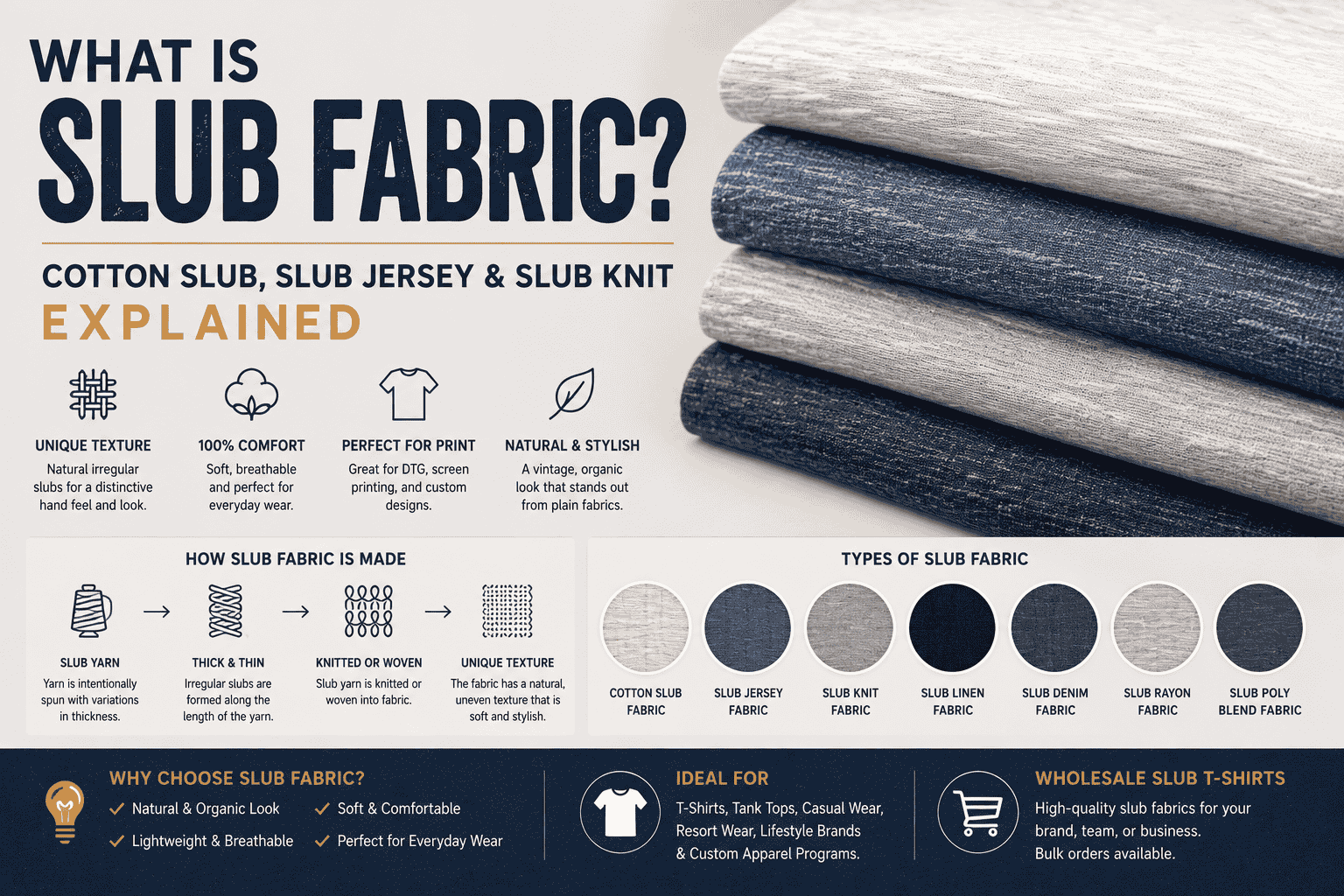
Quick answer: Slub fabric is a textile made from yarn with intentional thick-and-thin variations along its length — producing a naturally irregular, textured surface with subtle bumps and ridges. The word 'slub' refers to a lump or irregularity in yarn. Slub fabric is not defective. The texture is a deliberate design choice that creates a vintage, handcrafted, and organic aesthetic.
If you have ever held a t-shirt whose surface looked slightly uneven — with thin and thick patches, subtle bumps, and an organic texture that smooth plain jersey doesn't have — you were holding slub fabric. Slub is one of the most misunderstood fabric terms in the apparel market because at first glance the texture can look like a manufacturing flaw. It isn't. The irregularity is the point.
This guide explains everything you need to know about slub fabric: what it is, how it is made, what types exist, how it behaves when decorated, and when to choose it for a wholesale t-shirt or apparel program.
What Is Slub Fabric? — The Complete Definition
Slub fabric is any fabric woven or knitted from slub yarn — yarn that has been intentionally spun with deliberate thick and thin variations along its length rather than a uniform, consistent diameter throughout. These variations create the characteristic irregular surface of slub fabric: some areas are slightly thicker and more opaque, while others are slightly thinner and more translucent.
The word 'slub' has been in the English language since the 18th century. It originally described an imperfection in hand-spun wool — a section of fiber that was not fully drafted before spinning, creating a bump in the yarn. Early hand-spinning was inconsistent, and slubs were genuine defects that reduced fabric quality. Modern slub fabrics deliberately recreate this irregularity at industrial scale. What was once a defect is now a designed aesthetic.
Key distinction: In modern slub fabric, the irregular texture is intentional and controlled — not accidental. A slub fabric is not defective yarn improperly processed. It is yarn engineered with deliberate variation to produce a specific visual and tactile result.
How Is Slub Fabric Made? — The Yarn Process
Slub yarn is produced by intentionally varying the drafting speed during spinning — the stage of yarn production where fibers are drawn out and twisted into yarn. When the drafting rollers slow down or speed up at irregular intervals, the amount of fiber being twisted into the yarn at that moment changes:
-
When drafting slows: more fiber is incorporated at that point, creating a thicker slub section
-
When drafting speeds up: less fiber is used, creating a thinner section
Modern spinning machinery can program these variations precisely — controlling the length, thickness, and spacing of slubs throughout the entire yarn. The result is a yarn that produces a predictable, repeatable irregular pattern in the finished fabric — not random defects.
Slub yarn can be made from virtually any fiber: cotton, linen, silk, polyester, rayon, and blends. Each fiber produces different visual and tactile characteristics in the finished slub fabric. In the wholesale apparel market, cotton slub and cotton-poly slub are the most common constructions for t-shirts and casual knit tops.
7 Types of Slub Fabric — Cotton Slub, Slub Jersey, Slub Denim & More
1. Cotton Slub Fabric
Cotton slub fabric is the most popular slub construction in the wholesale t-shirt and casual apparel market. It uses slub yarn spun from 100% cotton fibers — producing a fabric that looks softer and more organic than standard plain cotton jersey. Cotton slub is most commonly found in casual lifestyle t-shirts, tank tops, and lightweight tops where a natural, bohemian aesthetic is desired.
-
Hand feel: softer and more pliable than standard ring-spun cotton; slightly irregular surface
-
Weight: typically 3.5–4.5oz — lighter than standard cotton jersey at the same thread count
-
Best for: lifestyle t-shirts, casual tops, beach and resort programs, women's fashion
Explore cotton t-shirts at Simplstc Apparel — including cotton slub and standard ring-spun options.
2. Slub Jersey Fabric
Slub jersey is the knitted version of slub fabric — slub yarn knitted into a jersey (single-knit) structure. Jersey knit is the standard construction for all t-shirts. When slub yarn replaces uniform yarn, the knitted fabric develops the characteristic irregular surface of slub while maintaining the stretch and drape of jersey. Slub jersey is the most common construction for slub t-shirts, slub tank tops, and slub long sleeve tees.
-
Construction: single-knit jersey using slub yarn
-
Stretch: 25–50% horizontal stretch — similar to standard jersey
-
Best for: t-shirts, tank tops, casual lifestyle tops
Explore short sleeve t-shirts and tank tops at Simplstc Apparel.
3. Slub Knit Fabric
Slub knit fabric is the broader category covering any knit structure — jersey, rib, interlock, or French terry — produced from slub yarn. Slub rib knit is popular for tank tops, neckline trims, and women's casual tops where a ribbed texture is desired alongside the slub irregularity. Slub French terry appears in lightweight sweatshirt and hoodie programs for a more organic, vintage feel.
-
Best for: t-shirts, casual knit tops, tank tops, lightweight sweatshirt programs
Explore pullover hoodies and sweatshirts for related casual knit programs.
4. Cotton-Poly Slub Fabric
Cotton-poly slub blends cotton slub yarn with polyester — typically in 50/50 or 60/40 ratios — adding wrinkle resistance and dimensional stability to the slub cotton's natural properties. The polyester content reduces the tendency of cotton slub to stretch out of shape and provides improved color retention through washing. Cotton-poly slub is the right choice when the slub aesthetic is desired alongside better garment durability.
-
Benefits vs 100% cotton slub: better dimensional stability, reduced wrinkling, improved color retention through washing
-
Best for: casual lifestyle programs, everyday wear, programs needing more durability than pure cotton
5. Slub Denim Fabric
Slub denim uses slub yarn in the warp threads of a standard denim twill weave — producing a characteristic irregular surface in denim fabric. Slub denim creates a more natural, vintage appearance because the thickness variation produces subtle light-and-shadow effects across the fabric surface, reminiscent of hand-woven or selvedge denim from earlier manufacturing eras. Popular in premium denim programs and heritage-adjacent lifestyle brands.
-
Appearance: subtle vertical irregularity in the denim surface; premium vintage denim aesthetic
-
Best for: premium denim programs, heritage and vintage-aesthetic brands
6. Slub Linen Fabric
Linen naturally contains some slub-like irregularities due to the nature of flax fiber processing — flax fibers are variable in thickness, producing a naturally textured linen fabric. Slub linen deliberately amplifies these irregularities with pronounced thickness variations in the yarn. The result is a deeply textured, highly natural-looking fabric that emphasizes linen's inherent organic qualities. Popular for resort, beach, and sustainable lifestyle fashion programs.
7. Slub Silk / Dupioni
Silk slub — also called Dupioni silk — is one of the oldest and most prestigious slub fabrics. When two silkworms spin a cocoon together, their combined thread produces a naturally thick-and-thin silk yarn with pronounced visible slubs. Dupioni silk has a distinctive crisp texture, visible horizontal irregularities, and a characteristic sheen. Used in formal fashion, bridal, and luxury home decor programs rather than the wholesale apparel market.
What Does Slub Mean in Fabric? — The Terminology Defined
When you see the word 'slub' in a fabric description, it tells you one thing: the yarn used to make the fabric has deliberate thickness variations — and the finished fabric will have a naturally textured, slightly irregular surface rather than the perfectly smooth, uniform surface of standard cotton jersey or poplin.
When you encounter slub fabric in a wholesale context, expect:
-
Visual texture: a surface that is not perfectly smooth — subtle bumps, ridges, and thin patches create visual depth and interest
-
Natural appearance: the irregular texture reads as organic and handcrafted rather than industrially manufactured
-
Variation within the garment: two areas of the same shirt may look slightly different in texture and opacity — this is the intended effect, not inconsistency
-
Vintage aesthetic: slub fabric has a lived-in, broken-in appearance that complements heritage, lifestyle, and artisan brand aesthetics
Is slub fabric a defect? No. The irregular texture is intentional. A genuine defect (a hole, a dropped stitch, pilling) is structurally different from the deliberate irregularity of slub yarn. If your slub fabric surface looks slightly uneven, it is performing exactly as designed.
Slub Fabric vs Regular Cotton — Side-by-Side Comparison
|
Property |
Regular Cotton Jersey |
Slub Cotton Jersey |
|
Surface texture |
Smooth, uniform, consistent |
Irregular, textured, organic-looking |
|
Yarn construction |
Uniform diameter end to end |
Intentional thick-and-thin variations |
|
Visual appearance |
Clean, flat, industrial |
Natural, vintage, handcrafted-looking |
|
Fabric weight |
Heavier for equivalent softness |
Typically lighter — thinner slub sections reduce overall weight |
|
Drape |
Structured, holds shape well |
More fluid and drapey |
|
Opacity |
Consistent across the garment |
Slightly variable — thinner slub areas are more translucent |
|
Print compatibility |
Excellent — smooth and consistent surface |
Good — irregular surface requires extra attention |
|
Best aesthetic |
Clean, modern, corporate |
Vintage, organic, artisan, resort, boho |
|
Washing behavior |
Predictable shrinkage |
Similar to cotton; may deepen texture slightly after first wash |
|
Retail price support |
Standard wholesale positioning |
Slight premium positioning over standard jersey |
Printing on Slub Fabric — Complete Decorator Guide
The most important thing to know before decorating slub fabric: the irregular surface texture requires adjusted technique for every decoration method. Test prints before production runs are non-negotiable on slub.
Screen Printing on Slub Fabric
Screen printing on slub fabric is achievable but requires more care than printing on standard smooth cotton jersey. The thick-and-thin variations in the slub surface cause ink coverage to be slightly variable — thicker slub sections absorb more ink than thinner sections, potentially producing subtle texture in the printed area. For solid-color, bold graphic programs, this variation is typically minimal and does not significantly affect the visual result.
-
Ink type: water-based inks strongly preferred on slub — they penetrate the fiber more evenly than plastisol and produce a softer post-print hand on the irregular surface
-
Squeegee pressure: slightly higher than standard to ensure even ink penetration across both thick and thin slub sections
-
Best designs: bold, high-contrast graphics and clean text work best; fine-detail designs may show slight variation in resolution
-
Production rule: always run a test print on the specific slub fabric before committing to a full production run
Learn more about our screen printing service — pre-production samples available for all slub programs.
DTF Printing on Slub Fabric
DTF (direct-to-film) printing transfers a printed design from a film onto the fabric using heat and pressure. Because DTF sits on top of the fabric surface rather than penetrating it, the print area can flatten some of the slub texture in the zone where the transfer is applied. For programs where the slub texture is the primary aesthetic, consider keeping the DTF print smaller and positioned where texture compression is less visible.
-
Result: clean, accurate color reproduction across the print zone; the print area will feel and look slightly different from the surrounding unprinted slub fabric
-
Best designs: complex multi-color and logo programs where color accuracy matters more than preserving the full slub texture in the print area
-
Best placement: left-chest or right-chest placement rather than large full-front coverage preserves more of the visible slub texture
See our DTF printing service for technical specifications.
Embroidery on Slub Fabric
Embroidery is one of the most effective decoration methods for slub fabric — the textured background of slub actually enhances the premium appearance of stitched logos by creating visible contrast between the flat embroidery and the organic fabric surface. The result is a decorated garment that reads as genuinely artisan and premium.
-
Key requirement: always use a cut-away or tear-away backing stabilizer for embroidery on slub — without stabilizer, the irregular fabric surface causes needle distortion and stitch shifting
-
Stitch density: keep stitch count moderate — very high-density embroidery (15,000+ stitches) can pucker slub fabric more than standard jersey
-
Best placement: left-chest logo (the standard) — the slub background makes a stitched logo read as an intentional premium detail
See our embroidery service for guidance on slub fabric programs.
Who Should Use Slub Fabric? — Programs and Brands
Slub fabric is not the right choice for every wholesale program. Its irregular texture serves specific brand aesthetics and customer audiences. Here is where slub fabric wins and where standard cotton is the better call:
Slub Fabric Works Best For
-
Beach, resort & coastal lifestyle brands: the organic, textured appearance reads as natural and relaxed — the defining aesthetic for beachwear, resort merchandise, and coastal lifestyle collections
-
Bohemian & artisan fashion brands: slub's handcrafted-looking texture aligns directly with the boho and slow-fashion brand aesthetic where natural and imperfect is the value
-
Women's lifestyle retail: slub jersey's fluid drape and soft texture make it popular for women's casual tops, tank tops, and lightweight knit programs
-
Yoga, Pilates & wellness studios: slub fabric's organic feel and lightweight construction communicate natural comfort and mindful materials
-
Heritage & vintage-aesthetic brands: the irregularity of slub evokes hand-woven, pre-industrial textiles that heritage and Americana brands romanticize
-
Craft breweries & farm-to-table restaurants: slub t-shirts communicate artisanal authenticity for businesses built around handcrafted, small-batch products
Standard Cotton Is the Better Choice For
-
High-volume screen printing programs: smooth cotton jersey (Gildan 5000, Bella+Canvas 3001) provides more consistent ink coverage at scale than slub's irregular surface — explore cotton t-shirts
-
Corporate uniform programs: the irregular texture of slub reads as casual and artisan — not appropriate where a clean, polished professional appearance is required
-
Athletic and performance programs: slub is a lifestyle fabric — athletic programs need moisture-wicking performance polyester
-
School athletic programs: team uniforms require consistent, predictable fabric for consistent decoration results across a full roster of sizes
What to Know Before Ordering Slub Fabric in Wholesale
Important: slub fabric garments photographed on a wholesale site show the texture at one specific point in the fabric. The garment you receive will have the same general texture pattern distributed differently across the surface. This variation is correct and expected — it is not a quality inconsistency.
Sizing and Fit
Slub jersey fabric typically has slightly more stretch than standard jersey because the thinner sections of yarn have less fiber and more give. Slub garments may run slightly larger than equivalent styles in standard jersey at the same nominal size. For wholesale programs ordering slub for the first time, order samples in each size before committing to a full-run quantity.
Washing and Care Instructions
Wash slub cotton in cold or warm water. Tumble dry on low heat. The first wash may slightly increase the visibility of the slub texture as the thinner sections of fabric relax and soften — this is normal behavior, not fabric failure. Do not dry slub cotton on high heat; uneven heat exposure across the thick and thin yarn sections can cause uneven shrinkage.
Color Appearance Across the Garment
Because slub texture creates light-and-shadow variation across the fabric surface, the same dye color can appear slightly different in shade across a single garment — thicker slub sections reflect less light and appear marginally darker; thinner sections appear slightly more translucent. This is an inherent characteristic of slub fabric, not a dye inconsistency or quality problem. Programs requiring perfectly uniform, consistent color across the garment surface should use standard smooth cotton jersey.
Slub Fabric vs Heathered Fabric — The Key Difference
Slub and heathered fabrics are sometimes confused because both produce a non-uniform visual appearance. They are fundamentally different:
-
Slub fabric: texture variation is in the YARN THICKNESS — the fabric has physical bumps and thin patches you can feel with your fingers; the variation is tactile
-
Heathered fabric: color variation is in the YARN FIBER — two differently-colored fibers are spun together, creating a mottled, flecked color appearance; the fabric surface is smooth
A fabric can be both slub and heathered simultaneously — slub yarn made from mixed-color fibers produces both the physical texture of slub and the visual mottling of heather. Tri-blend fabrics such as the Bella+Canvas 3413 have a heathered appearance without slub texture.
Slub Fabric vs Other Specialty Fabrics — Quick Reference
|
Fabric |
What Makes It Different |
Visual Effect |
Best For |
|
Slub cotton |
Thick-and-thin yarn variations |
Organic, irregular texture; natural bumps |
Lifestyle, bohemian, beach, vintage programs |
|
Garment-dyed cotton |
Dyed after construction |
Muted, washed tones; slight distortion |
Vintage streetwear, Southern lifestyle, craft brands |
|
Heathered fabric |
Mixed-color fibers in yarn |
Mottled, flecked color; smooth surface |
Premium casual, athletic-lifestyle hybrid programs |
|
Tri-blend fabric |
Three fibers: poly, cotton, rayon |
Extremely soft; heathered; drapey |
Lifestyle brands, yoga programs, boutique retail |
|
Ring-spun cotton |
Twisted spinning for finer yarn |
Softer and smoother than open-end |
Corporate casual, school programs, lifestyle |
|
Combed ring-spun |
Combed before spinning; finest yarn |
Ultra-smooth, premium soft hand-feel |
Boutique retail, lifestyle brands, Bella+Canvas 3001 |
Which Wholesale T-Shirt Is Closest to Slub Fabric?
Slub fabric t-shirts are a specialty category in the wholesale market. If slub is not available for your program or you want the closest visual alternative, here are the best options by aesthetic goal:
-
For the organic, natural texture aesthetic: Comfort Colors 1717 garment-dyed ring-spun cotton — the washed, muted tones and slightly irregular dye distribution create a similarly organic, vintage-feeling aesthetic
-
For the soft, lightweight, drapey feel of cotton slub: Bella+Canvas 3001 Airlume combed ring-spun — the smoothest, softest standard wholesale cotton tee; the closest in hand-feel to quality cotton slub without the surface texture
-
For the vintage, lived-in aesthetic: Comfort Colors 1717 in garment-dyed soft pastels or naturals — picks up where slub leaves off in producing an authentically vintage-looking garment
-
For the lightweight bohemian drape: Next Level Apparel or Bella+Canvas tri-blend styles — the rayon content in tri-blend produces a fluid, drapey garment quality that mirrors slub cotton's characteristic drape
-
For the organic, sustainable brand story: Allmade AL2100 GOTS-certified organic cotton — the natural fiber story and organic construction align with the values that often drive slub fabric selection
Explore all options in the cotton t-shirts and short sleeve t-shirts catalogs at Simplstc Apparel.
FAQs — What Is Slub Fabric?
What is slub fabric?
Slub fabric is a textile made from slub yarn — yarn intentionally spun with deliberate thick-and-thin variations along its length. These variations produce a naturally irregular, slightly textured surface in the finished fabric. The texture is a designed aesthetic feature, not a defect.
What does slub mean in fabric?
'Slub' refers to a lump or thick section in a yarn. In fabric terminology, 'slub' describes textiles made from yarn with intentional thickness variations — producing a fabric with a naturally organic, irregular surface rather than the smooth, uniform surface of standard cotton jersey.
What is cotton slub fabric?
Cotton slub fabric is slub fabric made from 100% cotton slub yarn. It is the most popular slub construction for wholesale t-shirts, tank tops, and casual knit tops. Cotton slub produces a softer, more pliable, and more naturally-looking fabric than standard smooth cotton jersey.
What is slub jersey fabric?
Slub jersey is slub yarn knitted into a jersey (single-knit) structure — the same construction used for standard t-shirts, but with slub yarn instead of uniform yarn. Slub jersey maintains the stretch and drape of standard jersey while adding the organic, textured appearance of slub fabric.
What is slub knit fabric?
Slub knit fabric is any knit structure — jersey, rib, interlock, or French terry — produced from slub yarn. Slub jersey is the most common. Slub rib knit is popular for tank tops and neckline trims.
Is slub fabric good for screen printing?
Slub fabric can be screen printed, but requires adjusted technique. The irregular surface produces slightly variable ink coverage — water-based inks, moderate squeegee pressure, and a pre-production test print are strongly recommended. Bold, high-contrast designs work better than fine-detail graphics on slub. See our screen printing service.
What is the difference between slub fabric and heathered fabric?
Slub fabric has physical texture variation — bumps and thin patches you can feel with your fingers, created by thick-and-thin yarn construction. Heathered fabric has color variation — two differently-colored fibers spun together create a mottled appearance, but the surface is smooth. A fabric can be both simultaneously.
What wholesale t-shirt is closest to slub fabric?
The Comfort Colors 1717 garment-dyed tee is the closest wholesale alternative for the vintage, organic aesthetic. The Bella+Canvas 3001 Airlume combed ring-spun is the closest in softness and drape. The Allmade AL2100 organic cotton is the closest for the natural fiber and sustainability story. See the full cotton t-shirts catalog at Simplstc Apparel.

Need Help?
Get in touch with our experts.