What Is Sublimation Printing? How Dye Sublimation Works on Shirts & Fabric — Complete Guide
If you have ever seen a sports jersey, athletic uniform, or lifestyle garment covered in a full-color pattern that goes edge-to-edge with no visible print borders or raised surface, you were looking at sublimation printing. It is the technology behind every all-over-print shirt, every NBA uniform, every custom cycling jersey, and an increasingly large portion of the custom branded merchandise market.
This guide explains everything about sublimation printing — the science behind how it works, step-by-step process, which fabrics it works on (and which it doesn't), cost per shirt, how it compares to screen printing and DTF printing, and whether it's right for your program.
What Is Sublimation? — The Science Explained Simply
In chemistry, sublimation describes a phase transition where a solid material converts directly into gas — bypassing the liquid phase entirely. Most people learned this in school as the transition ice makes when it converts directly to water vapor in dry conditions, or the way dry ice (solid CO2) produces fog by converting directly to CO2 gas without becoming liquid CO2 first.
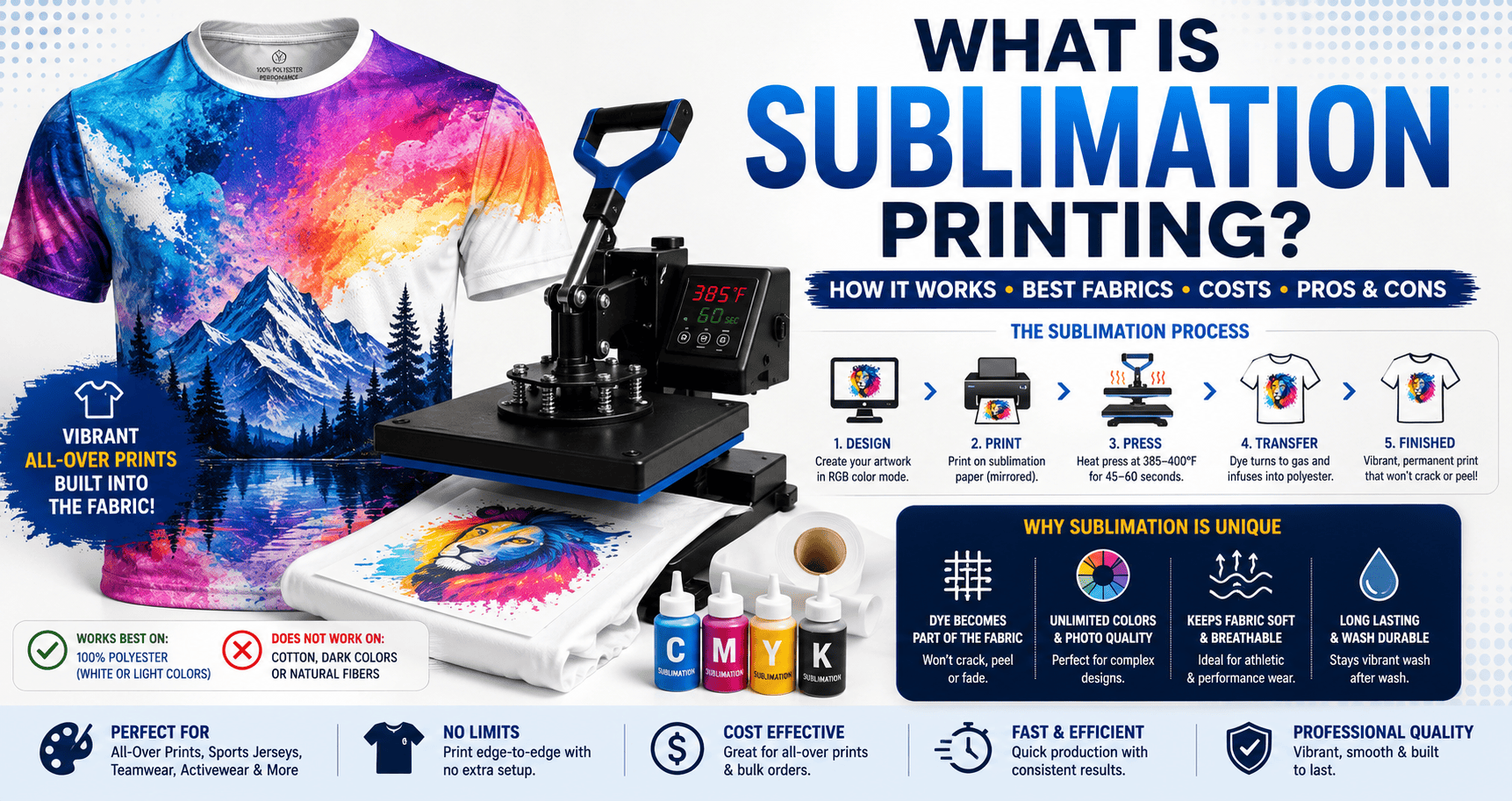
Dye sublimation printing applies this same physical process to textile decoration. The process uses specially formulated sublimation dyes — solid dye particles in an ink carrier. These dyes have a specific property: at temperatures above 375–400°F (190–205°C), they convert from solid directly into gas without becoming liquid.
When this gaseous dye encounters an open polyester fiber in the same heat environment, it penetrates into the fiber's molecular structure and solidifies inside the fiber — permanently bonding at the molecular level. When the heat is removed, the fiber closes and traps the dye permanently inside the fiber structure.
The critical insight: sublimation dye does not sit ON TOP of the fabric. It is absorbed INTO the fabric's molecular structure. This is why sublimated prints cannot crack, peel, or wash off — the dye is not a coating; it is part of the fiber itself.
What Is Dye Sublimation Printing? — The Textile Process Explained
Dye sublimation printing is the application of the sublimation phase transition to textile and hard-substrate decoration. Here is the complete process:
-
Design creation: the artwork is created digitally at full garment size in RGB color mode. For a typical adult t-shirt, the design file covers approximately 16" x 20" — the full front panel or the full garment in an all-over print. The design can be any complexity: photographic images, gradients, patterns, solid colors, or any combination. There are no color limits and no screen setup required.
-
Printing to sublimation paper: the design is printed onto a special coated transfer paper using a sublimation printer (a modified inkjet printer loaded with sublimation inks). On the paper, the sublimation inks look pale and washed-out — this is correct and expected. The true colors only become apparent during the heat transfer step. The printed design is a mirror image of the final design.
-
Positioning: the printed sublimation paper is placed face-down against the white polyester substrate — positioned precisely where the design should appear on the finished garment.
-
Heat press transfer: the paper and garment are placed in a heat press set to 375–400°F with firm, even pressure. The press applies heat and pressure for 45–60 seconds. At these temperatures, the sublimation inks on the paper convert from solid to gas and immediately penetrate the open polyester fibers.
-
Peeling: the heat press opens and the paper is peeled away — hot peel, immediately after pressing. The paper is blank where the design was — all dye has transferred into the polyester fibers.
-
Finished garment: the sublimated design is now permanently part of the fabric. The print is washable, does not require special care, and will maintain its quality for the life of the garment under normal use.
✓ Pro Tip: The colors on the sublimation paper look washed-out before pressing — typically 30–40% less saturated than the final result. This is correct sublimation dye behavior. The colors activate and intensify during the heat transfer step. Do not adjust the design based on how it looks on the paper before pressing.
What Fabrics Does Sublimation Printing Work On?
⚠ Sublimation ONLY works on polyester or polyester-coated substrates — and ONLY on white or very light-colored backgrounds. This is the most important limitation to understand before planning any sublimation program. Sublimation dye bonds with polyester fibers; on cotton or other natural fibers, the dye washes out completely after the first wash.
100% White Polyester — The Ideal Sublimation Substrate
100% white polyester is the optimal sublimation substrate. The polyester fiber is fully open to the sublimation dye during the heat press step and provides the maximum color vibrancy and print durability. White is required because sublimation inks are transparent — there is no white sublimation ink. The white of the garment itself serves as the white in the design.
-
Result: maximum color vibrancy; prints are permanent; no texture change from printing; print is part of the fabric
-
Best for: athletic uniforms, all-over print lifestyle shirts, sports jerseys, cycling kits, custom team uniforms
Best wholesale blanks for sublimation: Augusta Sportswear performance polyester tees, Badger Sport B-Core performance tees, and C2 Sport performance styles — all 100% polyester in white.
Light-Colored Polyester — Acceptable with Color Shift
Very light colors (pale yellow, light pink, light blue, light grey) on 100% polyester will sublimate — but the garment's base color affects the final print colors, because sublimation dye is transparent and blends with the underlying fabric color. A design with white areas on a light yellow shirt will show yellow instead of white in those areas.
-
Result: acceptable color output with slight color shift in light areas of the design
-
Best for: programs where the base color of the garment is intentionally incorporated into the design
Dark Polyester — Not Suitable for Sublimation
Sublimation does not work on dark-colored polyester. Because sublimation inks are transparent, they cannot override the dark base color of the fabric. A sublimation design printed on a navy polyester shirt will be essentially invisible. If you need all-over printing on dark garments, DTF (direct-to-film) printing is the appropriate alternative.
Cotton — Sublimation Does Not Permanently Bond
Sublimation does not work on 100% cotton. Cotton fibers have a different molecular structure from polyester — sublimation dye does not bond permanently with cellulose fibers. The dye will appear on the cotton fabric immediately after pressing, but washes out after the first wash, leaving a badly faded, uneven ghost of the original design.
⚠ Never attempt sublimation on cotton shirts. The result is a permanent waste of time and materials. For full-color printing on cotton, use DTF printing (direct-to-film), which works on any fabric.
Polyester-Cotton Blends — Partial Results
Polyester-cotton blends produce partial sublimation results — the dye bonds with the polyester content but not the cotton content. A 50/50 blend produces results that are approximately 50% as vibrant as pure polyester, with a faded, vintage-looking appearance. Some programs use 65/35 poly-cotton blends intentionally to create a soft, muted vintage sublimation aesthetic.
-
65/35 poly-cotton: produces a faded, vintage aesthetic — intentional for some lifestyle brands
-
50/50 poly-cotton: significant color loss; not recommended for most programs
-
Less than 50% polyester: results are too faded for practical commercial programs
What Is Sublimation Printing on Shirts — What It Looks Like
Sublimation printing on shirts produces a result visually distinct from every other decoration method:
-
No raised surface texture: run your hand over a sublimated shirt and you feel only the fabric — not the print. The dye is inside the fiber, not on top of it. This is one of the most distinctive qualities of sublimation compared to screen printing (which has slight ink texture) or DTF (which has a thin transfer layer)
-
Edge-to-edge color: sublimation can cover the entire garment surface including seams, collar, and cuffs — all-over printing that no other method can achieve seamlessly
-
Photographic quality: gradients, photographs, and complex multi-color designs reproduce without any quality loss or banding — the same quality as a professional photograph
-
Breathability preserved: because the dye is inside the fiber rather than coating the fabric surface, the garment's breathability and moisture-wicking properties are maintained after sublimation — critical for athletic uniforms
-
No cracking or fading over time: sublimated prints maintain their quality through hundreds of wash cycles without cracking, peeling, or fading — because there is no surface coating to crack or peel
How Does Sublimation Work on Different Products?
Sublimation printing works on any substrate that contains or is coated with polyester or a polyester-equivalent polymer — not just fabric. This is what makes sublimation uniquely versatile across product categories:
-
Polyester apparel: t-shirts, jerseys, hoodies, leggings, shorts, socks — any polyester garment can be sublimated
-
Polyester-coated hard substrates: ceramic mugs with polyester coating, aluminum panels, phone cases, license plates — all coated to accept sublimation dye
-
Polyester soft goods: flags, banners, table covers, mousepads, tote bags in polyester — corporate event and trade show merchandise
-
Sublimation on shoes: white polyester uppers on athletic shoes can be sublimated — increasingly common in custom athletic footwear
Sublimation vs Screen Printing vs DTF — Complete Comparison
Choosing between sublimation, screen printing, and DTF printing is one of the most common decisions in decorated apparel. Each method has a specific optimal use case. None of the three is universally best.
|
Factor |
Sublimation |
Screen Printing |
DTF Printing |
|
Print location |
All-over, edge-to-edge |
Front, back, sleeve — defined placement zones |
Front, back, sleeve — defined zones (no true all-over) |
|
Fabric requirement |
100% WHITE polyester ONLY |
Cotton, poly-cotton, most fabrics |
Any fabric — cotton, poly, blends |
|
Color capability |
Unlimited — photographic quality |
1–6 colors standard; unlimited with simulated process |
Unlimited — full photographic color |
|
White ink |
No white ink — garment white shows |
White underbase adds cost on dark garments |
White underbase layer included |
|
Dark garments |
Cannot print on dark garments |
Works on dark (with white underbase) |
Works on dark fabrics |
|
Print feel |
No texture — print is INSIDE the fabric |
Slight texture on surface; soft with water-based inks |
Slight raised transfer layer on surface |
|
Durability |
Permanent — life of garment |
Excellent with proper curing |
Good — 5–7 years; better than consumer HTV |
|
Minimum quantity |
1 piece (no screens to set up) |
12–24 pieces economic minimum |
1 piece (no screens) |
|
Cost per shirt (print only) |
$8–$20 for all-over |
$2–$6 per shirt at volume |
$3–$10 per shirt |
|
Best for |
Athletic uniforms, all-over print lifestyle, jerseys |
High-volume simple logos and graphics on cotton |
Full-color designs on any fabric at any quantity |
How Does Sublimation Printing Work at Home — DIY Setup Guide
Sublimation printing can be done at home or in a small print shop with relatively accessible equipment. Here is what a home sublimation setup requires:
Equipment Required
-
Sublimation printer: a modified inkjet printer loaded with sublimation inks. Most home sublimation setups use a converted Epson EcoTank series (ET-2720, ET-3850) or a purpose-built sublimation printer (Sawgrass SG500 or SG1000). Cost: $200–$600 for a printer. Important: a sublimation printer is a dedicated piece of equipment — once loaded with sublimation inks, it cannot be used with standard inkjet inks.
-
Sublimation inks: specialized inks that convert to gas under heat. Available in CMYK (cyan, magenta, yellow, black) and used in the same way as standard inkjet inks. Cost: $30–$80 for a starter ink set.
-
Sublimation paper: a special coated paper that holds the sublimation inks during printing and releases them efficiently during heat pressing. Cost: $20–$40 per 100-sheet pack.
-
Heat press: a clamshell or swing-away heat press capable of reaching 375–400°F with consistent, even pressure distribution. A 15"x15" or 16"x20" platen covers most garment applications. Cost: $200–$500 for a quality home heat press.
-
White polyester blanks: 100% white polyester garments to print on. See the fabric section above for substrate requirements.
-
Heat-resistant tape: to secure the sublimation paper to the garment during pressing, preventing paper shift that causes blurry or double-image results.
Total minimum home setup cost: approximately $450–$1,200 depending on equipment quality. A mid-range home sublimation setup produces professional results comparable to commercial print shops for small runs.
✓ Pro Tip: Before investing in a sublimation setup, order sublimation transfers from a transfer supplier and press them yourself with just a heat press — this tests the sublimation process on your specific substrates without committing to a full printer setup. Many transfer suppliers sell individual sublimation prints for $1–$5 each.
Step-by-Step: How to Sublimate a Shirt at Home
-
Prepare the design: create or finalize your design in Photoshop, Illustrator, or Canva. Set the canvas to the exact print size at 300 DPI. Use RGB color mode. Mirror the design horizontally before printing — the transfer must be placed face-down on the garment, so all text and directional elements must be mirrored in the file.
-
Print to sublimation paper: load sublimation paper into the printer, coated side down. Print the design. The printed paper will look pale and washed-out — this is correct.
-
Preheat the heat press: set to 385°F (195°C) with medium-firm pressure. Allow 5 minutes for the press to reach a stable, even temperature.
-
Pre-press the garment: place the white polyester shirt on the heat press platen and press for 5–10 seconds with no paper. This removes moisture from the garment, which causes sublimation ghosting if not addressed.
-
Position the sublimation paper: place the sublimation paper face-down on the shirt in the correct position. Secure the edges with heat-resistant tape to prevent paper shift during pressing.
-
Press: close the heat press and apply heat and pressure for 50–60 seconds. Do not open the press mid-cycle.
-
Peel: open the press and immediately peel the paper away while everything is still hot — this is hot peel sublimation. Peeling cold causes the dye to re-solidify on the paper surface rather than remaining bonded to the polyester fiber.
-
Inspect: the design is now permanently bonded to the garment. Allow to cool before handling extensively. Check for any ghosting (blurry secondary image) — if present, it is caused by paper shift during pressing.
Sublimation Printing Cost — What Does Sublimation Cost Per Shirt?
Sublimation printing cost varies based on who is doing it — professional print shop vs home setup vs transfer supplier:
|
Quantity |
Professional Print Shop |
Home Setup (cost per shirt) |
Transfer Only (you press) |
|
1 shirt |
$15–$30 all-over print |
$5–$12 (excluding equipment amortization) |
$3–$8 (transfer) + heat press ownership |
|
6 shirts |
$12–$22 per shirt |
$4–$8 per shirt |
$2–$5 per transfer |
|
12 shirts |
$10–$18 per shirt |
$3–$7 per shirt |
$1.50–$4 per transfer |
|
24 shirts |
$8–$15 per shirt |
$3–$6 per shirt |
$1.25–$3.50 per transfer |
|
50+ shirts |
$6–$12 per shirt |
$2–$5 per shirt |
$1–$3 per transfer |
Blank cost is additional: white polyester performance tees cost $3–$8 per unit wholesale. Total sublimated shirt cost (blank + print): approximately $10–$38 per shirt depending on method and quantity.
✓ Pro Tip: For programs of 12+ identical all-over designs, a professional sublimation print shop is most cost-effective. For custom individual shirts (different design per shirt), home setup or the transfer-and-press method is most practical.
Sublimation Printing Pros and Cons — Is It Right for Your Program?
Advantages of Sublimation Printing
-
True all-over printing: the only method that achieves seamless edge-to-edge printing across the entire garment including seams — no other method comes close
-
No print texture: the print is inside the fabric fiber — no surface coating, no cracking, no peeling, no washing off
-
Unlimited colors: photographic quality full-color printing with no per-color cost — gradients, photographs, and complex multi-color designs are as affordable as single-color designs
-
Preserves fabric properties: polyester's moisture-wicking and breathability properties are fully maintained after sublimation — critical for athletic uniforms
-
No minimum quantity: unlike screen printing, sublimation has no screens to set up — one shirt is as economical to print as one hundred
-
Permanent durability: sublimated prints last the life of the garment — washing in warm water does not fade sublimated designs
Limitations of Sublimation Printing
-
White polyester only: the most significant limitation — sublimation does not work on dark fabrics, cotton, or natural fibers
-
No white ink: areas of the design intended to be white show the fabric color — the garment must be white to produce white in the design
-
Higher cost at low volume: per-shirt cost is higher than screen printing at very high volumes (100+ identical shirts)
-
Fabric feel can be stiff after all-over: full-coverage all-over sublimation can slightly affect the fabric drape and softness on lighter fabrics — less issue with heavier performance fabric
-
Cannot print on finished garments with elastics or rubbers: heat press temperatures can damage rubber waistbands, elastic, and certain trims on fully-constructed garments
Sublimation Printing on Fabric — Applications Beyond T-Shirts
Sublimation printing on fabric extends across the full range of polyester textile products — not just t-shirts. Here are the main fabric applications:
-
Athletic jerseys and uniforms: the primary professional application of sublimation — every NBA, NFL, and MLS uniform uses sublimation printing for the number and design elements because the print is breathable and does not degrade performance
-
Cycling jerseys: the all-over full-color design of professional cycling jerseys is always sublimation — the technical performance properties of the polyester fabric are fully preserved
-
Soccer and football uniforms: sublimation allows individual names and numbers on team jerseys without sewing on heavy twill letters
-
Swimwear: polyester swimwear is a primary sublimation substrate — chlorine-resistant polyester swimwear with custom designs
-
Yoga and activewear leggings: polyester-spandex activewear with all-over patterns — the most popular lifestyle sublimation garment category
-
Flags and banners: polyester flags and trade show banners are produced via sublimation — the full-coverage printing is possible with no white ink limitations (white areas in the design must be cut or left unprinted)
For athletic programs needing sublimated jerseys and uniforms, explore performance t-shirts from Augusta Sportswear, Badger Sport, and C2 Sport at Simplstc Apparel.
The New Section — Sublimation Printing vs DTF: Which Is Right in 2025?
DTF printing has disrupted the sublimation market significantly since 2021. Many programs that previously required sublimation can now be produced via DTF at lower cost, on more fabric types. Here is the honest current comparison.
DTF (direct-to-film) printing has significantly reduced the number of use cases where sublimation is the only or best option. Understanding where each method still wins in 2025:
Sublimation Still Wins For
-
True all-over printing: DTF requires a defined transfer area — sublimation can cover the entire garment seamlessly including under seams and in gussets. If the design needs to go EVERYWHERE, sublimation is still the only method.
-
Athletic performance garments: sublimation produces zero additional surface layer — the garment breathes, wicks moisture, and moves exactly as the blank fabric does. DTF produces a thin transfer layer that affects breathability in covered areas. For professional athletic programs, sublimation remains the standard.
-
Cost at scale on polyester: for 50+ identical all-over printed polyester shirts, sublimation print cost per shirt is lower than DTF at equivalent quality.
DTF Now Wins For
-
Dark garments: DTF prints on dark polyester, dark cotton, and any other dark fabric — sublimation cannot. For any program on navy, black, or any dark garment, DTF is the clear choice.
-
Cotton garments: sublimation does not bond to cotton — DTF works on 100% cotton, making it the full-color print option for cotton t-shirts from Gildan, Bella+Canvas, and Comfort Colors.
-
Small runs with complex designs: for 1–25 shirts with full-color designs, DTF at a transfer supplier is more accessible than sublimation for most small businesses.
-
Front/back placement on cotton or dark shirts: for standard front and back print programs, DTF is more versatile and less equipment-intensive than sublimation.
Explore our DTF printing service and screen printing service at Simplstc Apparel — both available from 12 pieces, no setup fee.
FAQs
What is sublimation printing?
Sublimation printing is a decoration process that uses heat (375–400°F) to convert solid sublimation dye directly into gas — which then permanently bonds into polyester fabric fibers. The result is a print that is literally part of the fabric structure: it cannot crack, peel, or wash off. Sublimation produces full-color, edge-to-edge (all-over) prints on white polyester substrates.
How does sublimation printing work?
Sublimation printing works in four steps: (1) design is printed onto sublimation paper using sublimation inks; (2) the paper is placed face-down on a white polyester garment; (3) a heat press applies 385°F heat and pressure for 50–60 seconds, converting the solid ink to gas that penetrates the polyester fibers; (4) the paper is peeled away, leaving the design permanently bonded inside the fabric.
What does sublimation printing work on?
Sublimation printing works only on white or light-colored 100% polyester and polyester-coated substrates. It does NOT work on cotton, dark fabrics, or natural fibers. For full-color printing on cotton or dark garments, DTF printing is the appropriate method.
Can you sublimate on cotton shirts?
No. Sublimation dye does not permanently bond with cotton fibers. The design may appear briefly after pressing but washes out almost completely after the first wash. Cotton requires a different print method — DTF printing or screen printing — for permanent decorated results.
What is the difference between sublimation and screen printing?
Sublimation: works only on white polyester, produces all-over edge-to-edge prints, print is inside the fabric (no texture), unlimited colors, no minimum quantity, cost $8–$20 per shirt. Screen printing: works on cotton and most fabrics, produces defined placement prints (front/back/sleeve), slight surface texture, 1–6 colors standard, 12–24 piece minimum for cost efficiency, cost $2–$6 per shirt at volume.
What is the difference between sublimation and DTF printing?
Sublimation: works only on white polyester, produces true all-over seamless prints, zero surface texture, athletic performance properties fully preserved. DTF: works on any fabric including cotton and dark garments, produces defined transfer area prints (not truly edge-to-edge), thin transfer layer on the fabric surface, slightly affects breathability in print areas. For dark or cotton garments, choose DTF. For athletic all-over prints on white polyester, choose sublimation.
How long does sublimation printing last?
Sublimation printing is permanent — the dye is bonded inside the polyester fiber structure, not coated on the surface. Sublimated prints do not crack, peel, or fade over the life of the garment under normal use and washing. This permanence is one of sublimation's primary advantages over vinyl and HTV methods.
Where can I get sublimation printing for custom shirts?
Professional sublimation printing is available for all-over-print athletic uniforms and lifestyle programs. For standard front/back print programs on any fabric, our DTF printing service and screen printing service at Simplstc Apparel offer custom decoration from 12 pieces with no setup fee. Explore performance t-shirts for white polyester blank substrates.


Need Help?
Get in touch with our experts.